


ICNA Relief Announces $250,000 to Support LA Wildfire Relief Work!
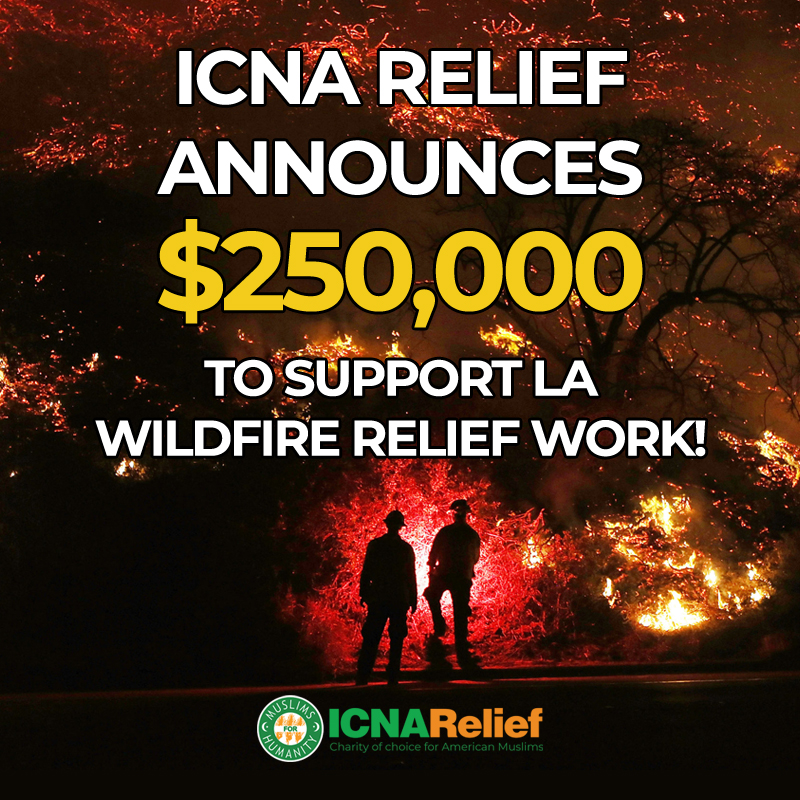
National Muslim Non-Profit Provides $250,000 in Relief Funds and Immediate Support to Families Impacted by L.A. Wildfires Los Angeles, California, January 12, 2025 – ICNA Relief USA, a humanitarian organization inspired by faith, has allocated $250,000 in relief funds and provided immediate support to over 3,000 families affected by the recent wildfires in Los Angeles. The organization is distributing essential supplies and offering critical assistance to those impacted by the disaster. Relief efforts include the provision of blankets, over-the-counter medications, hot meals, tents, sleeping bags, hygiene kits, and non-perishable food items. Additionally, trained counselors are on-site to provide emotional and mental health support to displaced families. “Our mission is grounded in the principle of serving humanity,” said AbdulRauf Khan, Chief Executive Officer of ICNA Relief USA. “We stand in solidarity with the people of California during this crisis and are committed to alleviating their suffering. By leveraging our resources and collaborating with local authorities, we aim to ensure aid reaches those who need it most as quickly as possible.” Upcoming Distribution Event: Today, January 12th, ICNA Relief USA will host a distribution event at the Dream Center (2301 Bellevue Ave, Los Angeles, CA 90026) at 3:00 PM. Families in need will receive essential items, including baby and adult diapers, wipes, and formula. Hot meals will also be provided to volunteers and first responders. Future events and distributions will be posted on the https://icnarelief.org/drs and community forums.As part of its ongoing efforts, ICNA Relief USA is assessing the long-term needs of wildfire-affected communities and developing sustainable recovery initiatives to help them rebuild their lives. How to Help: ICNA Relief USA is calling on individuals and businesses across the country to support its wildfire relief efforts through donations and volunteering. To contribute, visit https://icnarelief.org/drs. Every donation helps provide vital assistance to those impacted by the fires. About ICNA Relief: ICNA Relief USA is a non-profit organization dedicated to humanitarian service and disaster relief, guided by Islamic values of compassion and generosity. With a strong track record of responding to emergencies, the organization strives to bring hope and support to communities in need.
Statement Condemning the New Orleans Attack
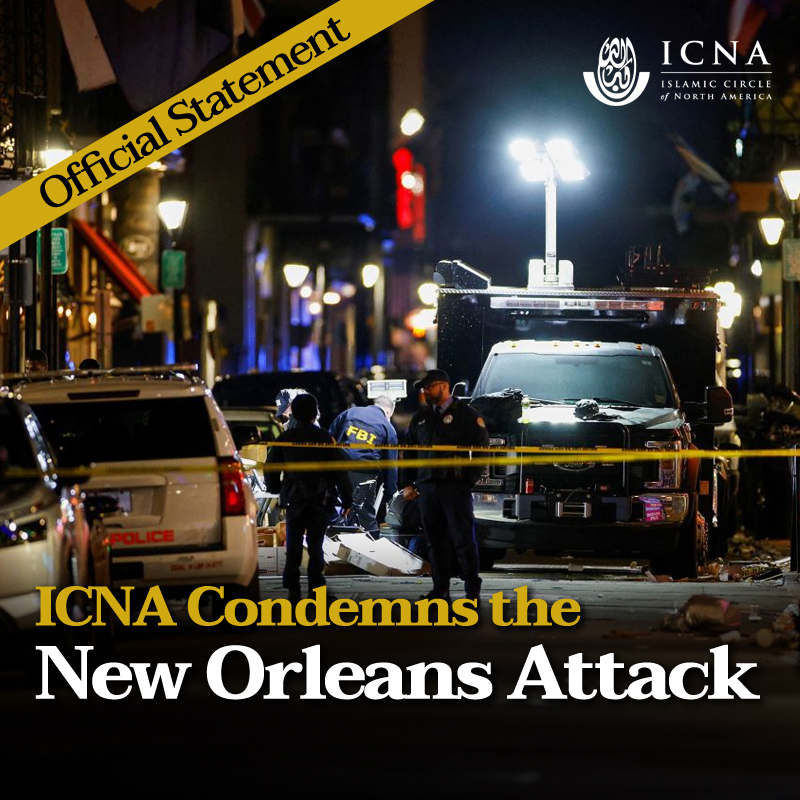
In the name of Allah, the Most Gracious, the Most Merciful. ICNA is deeply shocked and saddened by the heinous attack that has taken place in New Orleans. We extend our heartfelt condolences to the victims, their families, and the entire community affected by this senseless tragedy. Our thoughts and prayers are also with those injured, and we hope for their swift and complete recovery. As Muslims, we clearly condemn all acts of terrorism and violence, which have no place in our faith or humanity. Islam teaches compassion, justice, and the sanctity of life, and such actions are a direct violation of these principles as Allah SWT says: whoever kills a person, unless it is (in punishment by the authority) for murder or for spreading chaos in the land, then it is as if he has killed all of humanity. (Similarly), whoever saves a life, it is as if he has saved all humanity. (5:32) We also urge main stream media NOT to attack a faith due to actions of a deviated individual. There have been 488 mass shootings that took place in the USA in 2024. How many shooters were blamed for their acts because of their faith or lack of faith? Why did media not connect Brad Spafford of Virginia to his faith. FBI arrested this white man just two days back with 150 explosive devices. The Louisiana criminal is not an immigrant. He is a Texan army veteran of the Afghan war who was honorably discharged. ICNA also calls on people of all faiths and backgrounds to come together in unity and resilience against hatred and extremism in all its forms. We remain committed to fostering peace, understanding, and community support. Let this tragedy remind us all of the importance of rejecting division and embracing compassion and mutual respect. May we all work together to build a future, free of hate and violence!
Crisis in Sudan
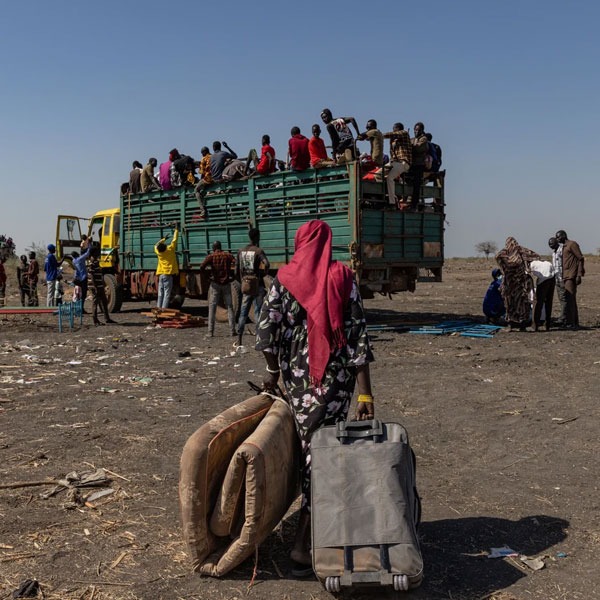
Sudan is in crisis as escalating conflict has caused mass displacement, an economic crisis, and a collapse of healthcare services. The war is a power struggle between the Sudanese Armed Forces and the Rapid Support Forces. Officials estimate that the violence in Sudan has killed at least 15,500 people, while other estimates are as high as 150,000. Sudan’s crisis can be understood through the past decades of political instability. In 2019, the removal of authoritarian leader Omar al-Bashir was at first a hopeful development for a return to civilian rule in Sudan. However, a military coup in 2021 dissolved the civilian government. This triggered political and economic turmoil and has stoked the flames of internal conflicts in the country. The war has pushed over 25 million Sudanese civilians in need of humanitarian aid, which is more than half of Sudan’s population. “United Nations investigators have reported that the country is in the grips of mass famine, although an official famine designation has not been made. The euphemism of food deprivation is presently being used to describe the dire food situation in Sudan.” Millions of people have fled their homes due to the violent crisis, with upwards of 12 million people displaced. Most people remain in the country, meaning that this is one of the largest displacement crises in the world. Sudan is also affected, as much of the rest of the Global South, by global climate change. Floods and droughts across the country have created unlivable conditions, with mass crop and livestock destruction. Attacks on the healthcare infrastructure have created conditions where people are not able to access lifesaving care. UNHCR reports that almost three quarters of health facilities are out of service, and diseases including cholera, measles, and malaria are spreading. They also estimate that two-thirds of the population lacks access to healthcare. The conflict does not exist in a singular vacuum – Western countries and African nations have a role to play in the violence. Egypt, Saudi Arabia, the UAE, and Israel have played key roles in exacerbating the conflict. The Arab Center in DC reports that these groups have a vested interest in preventing Sudan from having a civilian and democratic government. The Gulf Arab countries have strong relations with the former regime of Omar al-Bashir. Al-Bashir previously sent military assistance and troops against the Saudi and UAE war against the Houthis in Yemen in 2015. Saudi Arabia also has economic and financial “investments” across the agriculture, energy, water, sanitation, transportation, and telecommunications sectors in Sudan. Israel is attempting to normalize diplomatic relations with Sudan, and has a vested interest to do so. In 2020, the UAE arranged a secret meeting between Hemedti, a general in the RSF, and the then director of Mossad (Israeli intelligence/propaganda arm). The many state and non-state actors invested in destabilizing Sudan are responsible for the horror that Sudanese people are going through. When understanding a conflict like this, it’s important to highlight each angle – from geopolitical interests to climate change to gender. Global agencies such as the UN and Amnesty International have addressed the violence in Sudan – advocating for a ceasefire between the fighting factions and a cessation of military support. Amnesty International published a report in 2023 detailing the conflict and violence. It is further problematic that Sudan is not a well-known issue in mainstream Muslim society. We must increase awareness about Sudan as our Muslim brothers and sisters in the country are suffering. The Quran in Surah Al-Imran, Verse 3 says, “You are the best community ever raised for humanity—you encourage good, forbid evil, and believe in Allah. Had the People of the Book believed, it would have been better for them. Some of them are faithful, but most are rebellious.” Through this, we can understand that Muslims must embrace justice and forbid that which causes injustice. The situation in Sudan is one where we must rise and denounce the injustices of the warring factions, and instead promote peace, raise awareness, and give aid. As of today, hundreds of thousands of Sudanese civilians are afflicted with dehydration, starvation, and disease caused by conflict. We make a call to those who can help to donate to Sudan relief. Check out Helping Hand for Relief and Development campaign for Sudan aid and make a donation to help address the situation in Sudan. Continue following ICNA CSJ as we update the situation in Sudan through policy and advocacy. Read Other Articles on icnacsj.org
To Be Grateful
We always want more. Isn’t that the fundamental human experience? Always feeling inadequate, unfulfilled, like something’s missing. We could have the whole world and everything in it, and it still wouldn’t be enough. There’s a reason Jannah is such a powerful motivator, with its promises of bliss that never fades nor grows old. Isn’t that the ultimate dream? But instead of always seeking more in a never-ending quest for happiness, what if we tried to recognize the blessings we have in our lives and sincerely be thankful for them? I was married on October 5, 2024, and it was not the easiest journey. I was first introduced to my husband more than a year ago. We spoke over the phone twice and met in person once, but almost immediately we independently realized the relationship wasn’t going anywhere. So, we told our respective parents as much and ended the conversation pretty quickly. And yet, for the next six months wherein we had no contact, I couldn’t shake this nagging feeling out of my heart this was whom I was meant to marry. Even after we ended things, even after I told my parents “no,” in my heart I was still making dua for him. Because despite how ridiculously contradictory my actions were to my feelings, I knew it was meant to work out, but I also knew it wasn’t the right time. Six months passed and we decided to give it one more shot; two months later we were engaged, and four months after that we were married. Allah’s plan is beyond perfect. When the time was right, when we had become right for each other, everything fell into place in the most beautiful of ways. Nevertheless, those four months of engagement felt infinitely slow and agonizing. Speaking objectively, four months is not a long time. However, when you’ve made the decision to spend the rest of your life with someone, every second away from them feels like a minute, and every minute feels like an hour, and it feels like the time will never come. Of course, it did come, and we were soon married alhamdulillah. But the test of patience didn’t end with our nikaah, and we were quickly forced to confront the reality of our situation. I live in Houston, and he’s based in Chicago. Neither of us is in a place where we can uproot our lives and move across the country, and while this is something we discussed before getting engaged, I don’t think either of us expected a long-distance relationship to be quite as challenging as we quickly realized it was. There is something so emotionally draining, so genuinely hard, about committing your entire existence to someone and then having to live more than a thousand miles away from them. Life quickly begins to feel like a ‘filler episode,’ like you’re floating in space, going through the motions of life meaninglessly until you see him again. Then when you do see him, lights flash, the world beams in color, your heart starts to beat again, and you feel like you have purpose once more. That is until the weekend is over and you go your separate ways, and you can feel the ache creeping back into your chest from the distance. Recently I complained about this to a friend, hoping for sympathy and comfort. Instead, her response forced me to pause and reflect. What a sad life I was choosing for myself. To live my day to day as if it meant nothing. To have put my all into one man, who may be deserving of it sure, but aren’t there also things I owe to myself? Don’t my parents deserve to have a daughter who serves them and treats each moment with them as precious? Don’t my siblings deserve a sister who’s present and makes time for them? Don’t my friends deserve my company, my conversations? And most importantly, doesn’t my Lord still have rights over me? Did He not give me purpose? Was I not created to worship Him and Him alone? Allah did not gift me with a husband for him to become my entire life. He is meant to be an addition to what already exists. A wonderful, kind, sweet addition but an addition nonetheless – not a replacement. The rest of the world did not vanish when I got married. Of course, it’s ridiculously difficult to be so far from him, but when I finally make the move across the country, I will be tested with distance from every single other person who I hold valuable. So instead of getting lost in the potential future, I have to live in the present and actively strengthen my connection with those who matter to me because this time with them is limited. That is the advice I was given, and while hearing it shook me to my core, it’s advice I’ve taken to heart. To live in the moment, to make the most of each second as it passes, that is the true test of gratitude. Can I thank Allah for allowing me to have a home to live in, for blessing me with family and friends, for each minute I get to call my husband? Am I going to spend this year resentful and frustrated or content and grateful? Am I going to value the gifts Allah has granted me now or be upset about the things He’s saved for me in the future? “Alhamdulillah ala kulli haal.” The Prophet (peace be upon him) taught us these words – “Praise be to Allah in all circumstances.” It doesn’t matter what test we’re faced with, whether it’s in regard to family, school, career, or anything else. We trust Allah and we trust in His perfect plan, and, with that trust, we are grateful to Him. Alhamdulillah. Read Other Articles on messageinternational.org
ICNA Elects Saad Kazmi as New President for 2025-2026 Term
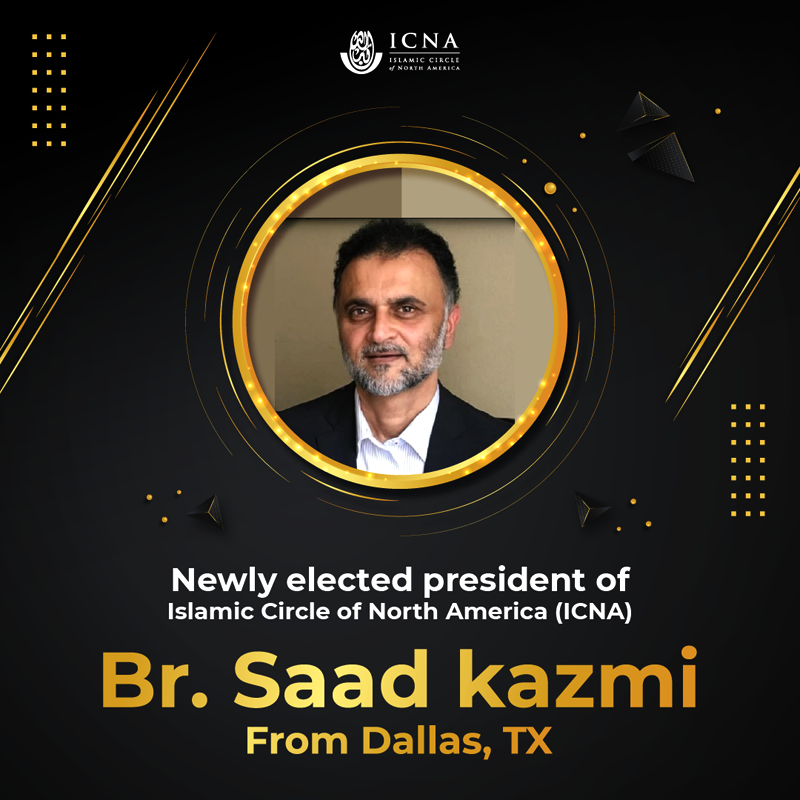
The Islamic Circle of North America (ICNA) is excited to announce that the current President Dr. Mohsin Ansari finished his four years term as the President of the organization and brother Saad Kazmi has been elected as the organization’s new President for the upcoming two-year term (2025-2026). Brother Saad Kazmi will take his oath on January 25th 2025, in the General Assembly meeting to be held at Houston Texas. The election results reflect a strong commitment from ICNA’s nationwide membership, with a robust turnout and active involvement in the process. Saad Kazmi, a pharmacist by profession, resides in Murphy, TX, and is a proud father of four. His leadership journey is rooted in a deep commitment to ICNA’s mission of building a society grounded in morality and God-consciousness. His election comes after a fair and transparent voting process conducted through an electronic voting system, ensuring broad participation and representation across ICNA’s diverse membership. This election was a historic moment for ICNA, as 80.4% members of the general assembly participated in the election process. Such widespread engagement exemplifies ICNA’s long-standing tradition of governance and shura, where members are directly involved in choosing their leadership. ICNA’s governance process, which has been in place for 50+ years, involves electing Presidents for a maximum of two, two-year terms, with the next two years marking an exciting new chapter under Kazmi’s leadership. His election underscores the trust and unity within the ICNA community, as the organization continues to grow and fulfill its mission through projects like ICNA Relief, Why Islam, Gain Peace, Helping Hands, Young Muslims, Embrace, Council of Social Justice and more. As the largest Muslim organization in the U.S., ICNA remains committed to serving its members and the broader community, striving to build a society rooted in justice, compassion, and faith. At this time we want thank our outgoing President Dr. Mohsin Ansari for his leadership, dedication and unparalleled commitment towards serving the Ummah of Prophet Muhammad PBUH and bringing ICNA to a level where we stand now. We look forward to the inspiring leadership that Saad Kazmi will bring, and we are confident that his vision will guide ICNA toward even greater impact in the years ahead. Welcome, President Saad Kazmi!
Muslims in America: The True Price of Living Here
Earlier this year, I traveled to Jordan with a relief organization. I spent a week visiting refugee camps sheltering countless Gazan and Syrian families, as well as individuals who have lost their families, including too many child orphans. Often when people visit refugee camps, they return with emotional messages, haunted by the tremendous pain and loss they have witnessed, stories of grieving widows, children without shoes, and nomadic campsites lacking water or basic human necessities. But beyond these personal narratives, something else comes to mind, a thought that boils the blood of every Muslim who cares. We ask ourselves what caused this immense pain and suffering. The answer? — carnage and destruction inflicted by people who care little about justice, who seem to care nothing about being the direct cause of human suffering. Yet, we know that the Lord is fully aware of what they do. And the Lord also knows what we do. So, where is the Muslim ummah, two-billion strong, in the pursuit of long-delayed, long overdue justice? Where are we, American Muslims, who enjoy the opportunities and conveniences of living in this country— what are we doing to bring about justice? Are we aware of and willing to pay the price of living here? Are We Willing to Pay the Price? The price of living here is you being angry about the injustices prevalent in the world and, therefore, engaged with the political system. The price of living here is you aiming to be the most pious practicing Muslim you possibly can be. You must be, when the land you call home is one of the most politically and economically powerful in the world. The price of living here is you regularly inviting others to Allah’s truth in a way that reflects the profound goodness of Islam: “Invite to the Way of your Lord with wisdom and kind advice…” (Qur’an 16:125). The price of living here is you never compromising on the truth of what Allah (SWT) has revealed and you living by it with firm resolve: “And do not incline toward the wrongdoers, or you will be touched by the Fire…” (Qur’an 11:113). The price of living here is you being required to learn about the worldwide impact of America’s political system as it morphed into a military-industrial complex, to be aware of how many innocent people that the oligarchy oppresses, and to recognize its taint of discrimination by race, class, national identity, religion, etc., both at home and around the world. As Muslims, we are called to care and act when we see injustice wherever it may be. How then can we watch a genocide unfold in Gaza and not engage with our political system? The Prophet (pbuh) said: “Whoever among you sees evil, let them change it with their hand… If you cannot, then with your speech; if you cannot, then hate it in your heart—and that is the least degree of faith” (Muslim). We see the state of the economy, the government corruption, the immorality of some politicians; and we see scores of people who feel frustrated and helpless. However, many Muslims cast their votes this month, determined to make themselves known as an important and integral part of this country’s political dynamics. They voted to make it clear there are hundreds of thousands of people who see the genocide taking place and cannot remain silent. Nonetheless, you may think, “I’m just one person, what can I do?” But this is exactly how the oppressors want you to think— that you are powerless, that you are insignificant. But that isn’t true, and the Prophet (pbuh) said wanting for your brother what you want for yourself is a sign of a believer, offering us hope in the importance of our compassion and our actions. The Prophet (pbuh) said, “None of you truly believes until he loves for his brother what he loves for himself” (Sahih al-Bukhari). Conversely, we also hate for our brothers and sisters what we hate for ourselves. Therefore, if we don’t desire genocide for ourselves, we cannot be complacent when we see others subjected to it. The Fight for Justice Can Never Cease However, the road isn’t always easy. Understand that when you struggle against evil you will likely face people who wish to see you silenced by any means necessary. These people have demonstrated in other lands the lengths they will go to dehumanize a group and commit war crimes against them. Nevertheless, Muslims’ fight for justice can never cease, particularly for those who live in the West. As followers of Islam, justice for all people is part of our faith-based worldview. We must fight for it until our last breath. We must stay focused, and we must plan, work, and strategize to inspire others as our ummah did in the past. If you find yourself falling short, remember the Prophet’s (pbuh) words: “The most beloved people to Allah are those who are most beneficial to others” (al-Ṭabarani). If we want to be beneficial to others as our Prophet (pbuh) advised us, and we hope to earn Allah’s love, I offer the following suggestions: Strengthen your relationship with Allah. Educate yourself and others. Volunteer your time and skills. Use your wealth for good. Speak out for justice even if your voice trembles. Engage with the political system to your best capacity. Reassess how you spend your time. Join and strengthen your Muslim community. Always keep your intentions pure. Most importantly, keep moving forward. Get up and get moving. For those already fighting in the way of justice, alḥamdulillah! There are so many amazing men, women, and youth working for noble causes worldwide and doing what’s required of them by fulfilling their promises to Allah (SWT). “Among the believers are men true to what they promised Allah…” (Qur’an, 33:23). However, if you’re ever struggling to live up to this noble stature, having difficulty in implementing any of the above suggestions, let the coming Day of Judgment be your inspiration. Imagine standing before
Statement from the Islamic Circle of North America (ICNA) on Amnesty International’s Genocide Findings
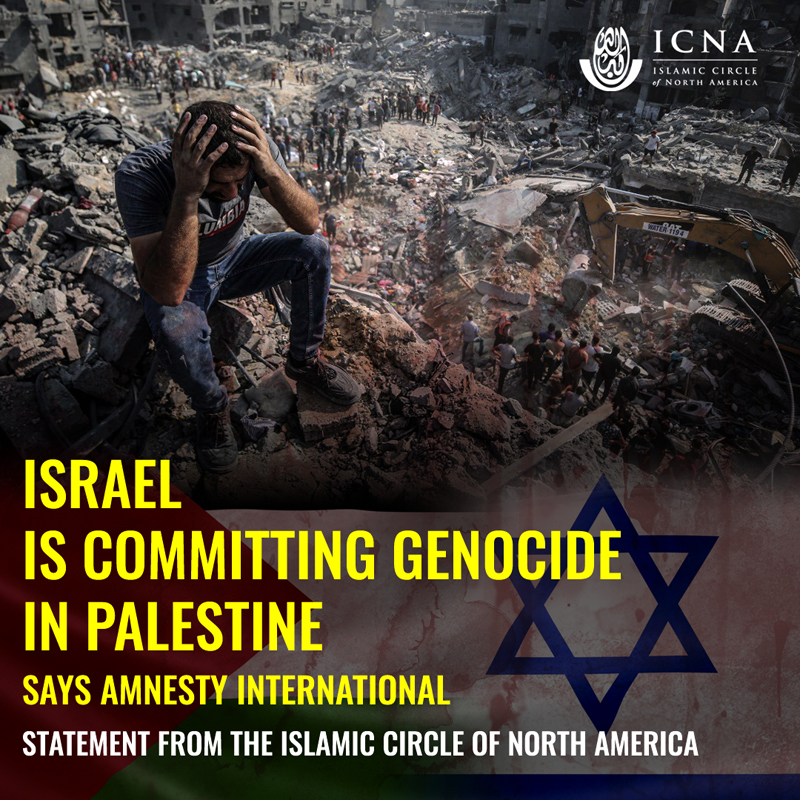
The Islamic Circle of North America (ICNA) stands in unwavering solidarity with the Palestinian people as we condemn the ongoing atrocities being committed by the Israeli government in Gaza. Recent findings from Amnesty International, which describe Israel’s actions as genocide against the Palestinian population, underscore the urgency for the international community to act decisively to halt the violence and protect innocent lives. Amnesty’s report, grounded in months of investigation and interviews with over 200 Palestinian victims, paints a chilling and devastating picture of the humanitarian catastrophe unfolding in Gaza. It details widespread and systematic attacks on civilian infrastructure, including the indiscriminate bombing of residential areas, the targeting of medical facilities, and the destruction of essential resources such as clean water and food. Furthermore, the forced displacement of thousands of innocent Palestinians is a clear violation of international law. Amnesty concludes that these actions constitute genocide, meeting the legal definition outlined by the United Nations. The report shows that these actions are not isolated incidents but part of a broader strategy by Israel to systematically destroy the Palestinian population in Gaza, both physically and culturally. Israel’s attacks, which have killed thousands of civilians, have caused intergenerational harm that will leave deep scars on the Palestinian people for decades to come. As Amnesty International rightly points out, the violence cannot be justified as mere self-defense—it is part of a deliberate effort to annihilate the Palestinian people. At ICNA, we call on the global community to take immediate steps to hold Israel accountable. The U.S. government, in particular, must reconsider its stance of uncritical support for Israel’s military actions. We urge the incoming Trump administration to take decisive action and de-fund this genocide. Instead, we call for a shift in focus toward addressing pressing domestic issues such as mental health, poverty, and racial inequality that impact millions of Americans. It is time to prioritize the well-being of American citizens over the uncritical funding of violence abroad. Additionally, we call on Congress to pass H.Con.Res.99, a concurrent resolution that honors Wadee Alfayoumi, a 6-year-old Palestinian-American boy who was tragically murdered in a hate crime because of his Palestinian-Muslim identity in Illinois. This resolution would recognize the loss of Wadee Alfayoumi, affirming that the United States has zero tolerance for hate crimes, Islamophobia, anti-Semitism, and anti-Palestinian and anti-Arab discrimination. It also emphasizes the importance of protecting constitutional rights, including freedom of speech and the right to peaceful protest. We also urge the International Criminal Court (ICC) to use the extensive evidence presented in Amnesty’s report to further investigate and prosecute those responsible for these crimes. This includes Israeli Prime Minister Benjamin Netanyahu and Defense Minister Yoav Gallant, who have been central figures in orchestrating and defending the violent and genocidal policies against Palestinians. Israel’s systematic campaign of violence should not go unpunished, and those who have spearheaded this violence must be held accountable in international courts. Finally, ICNA calls for the immediate cessation of hostilities in Gaza and for urgent humanitarian aid to reach those in desperate need. We call on governments worldwide to end their complicity in this genocide and to take meaningful steps to protect the lives of innocent Palestinians. The time for action is now. The world cannot afford to remain silent as genocide unfolds. At ICNA, we stand committed to amplifying the voices of the oppressed and advocating for justice, peace, and the protection of human rights. We urge all people of conscience to join us in demanding an end to the violence and in pushing for accountability for those responsible for the ongoing atrocities in Gaza.
Support ICNA on Giving Tuesday: Empower Communities and Strengthen Society
ICNA, a beneficial Muslim platform, to spread positivity during Giving Tuesday. ICNA is an organization of American Muslims dedicated to promote Islamic values by safeguarding moral, familial, and religious traditions. Through its various initiatives, ICNA fulfills its mission of service and outreach. Programs like WhyIslam and GainPeace help fulfill the obligation of spreading the divine message to neighbors and communities across the U.S. Social services such as ICNA Relief and Helping Hand for Relief and Development (HHRD) provide essential support, serving millions of people both in the U.S. and globally. Young Muslims (YM) empower the youth, both brothers and sisters, to take on leadership roles in the community, ensuring a strong and dynamic future. ICNA Sisters offers a vital platform for women to engage in strengthening families and society in accordance with Islamic values. ICNA Council for Social Justice addresses critical issues of discrimination and inequality, while conventions bring the Muslim community together as one family. By supporting ICNA, you contribute to these impactful programs and initiatives, strengthening communities and advancing these noble causes. DONATE NOW!
HHRD’s Lifesaving Relief Efforts in Gaza
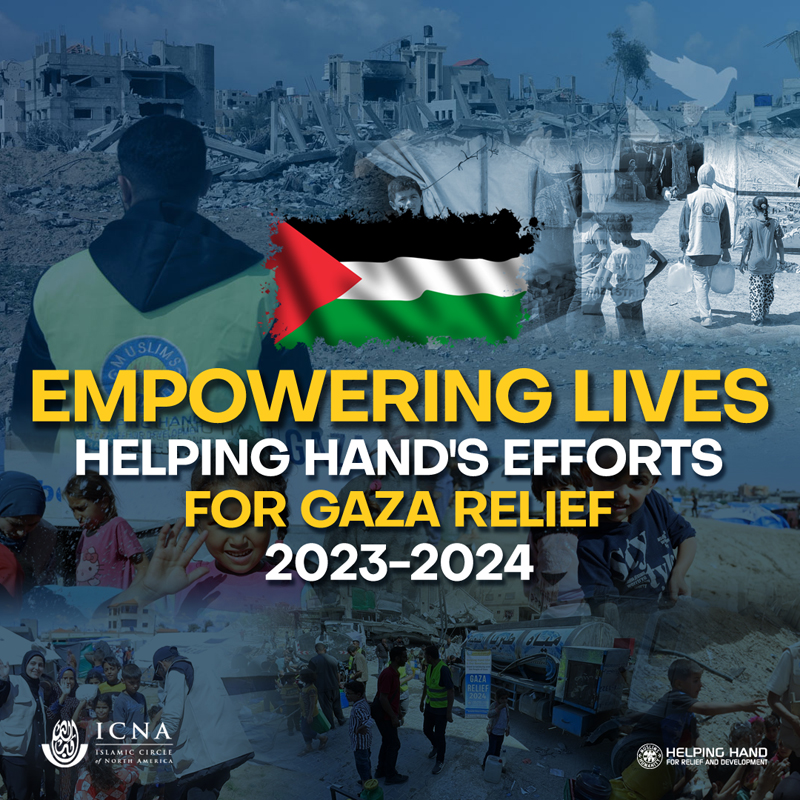
Since October 2023, Helping Hand for Relief and Development (HHRD) has been at the forefront of humanitarian efforts in Gaza, delivering critical aid to over half-a-million fellow human beings through multiple rounds of service. In the face of ongoing hostilities and devastation, HHRD’s relentless dedication has ensured that those affected receive the support they need to survive with dignity. The daily HHRD’s food and water distribution programs since May 2024 have been a lifeline for the people of Gaza, in providing food parcels, hot meals, bread, and clean drinking water. From Iftar dinners during Ramadan to daily sustenance, these initiatives have been crucial in alleviating hunger and malnutrition. Additionally, large-scale daily water distribution through tankers efforts have provided families with clean water, essential for maintaining health and preventing waterborne diseases. Beyond food and water, HHRD has addressed other urgent needs by distributing hygiene kits, blankets, sleeping bags, clothing, and medical supplies to vulnerable families. These items have significantly improved living conditions for those displaced by the conflict, offering a measure of comfort in challenging circumstances. In addition, HHRD has established washrooms in critical locations, ensuring that proper hygiene practices are maintained, which is vital for preventing the spread of diseases. Amid the hardships, a simple act of kindness can bring immeasurable joy. A child shared their story of how life drastically changed when they had to flee their home due to intense bombing. Living in a tent inside a school, they longed for the simple pleasure of eating bread, a staple that had been absent from their lives due to the scarcity of flour in Gaza. The child’s joy was indescribable when the HHRD team arrived with a large bag of flour, allowing their family to bake bread once again. This small yet profound moment of happiness rekindled hope, showing that even in the darkest times, acts of compassion can make a significant difference. HHRD’s work in Gaza is ongoing, with plans for more aid distributions in the coming months. The organization remains committed to standing by the people of Gaza, providing the resources they need to endure these difficult times. The road ahead may be challenging, but HHRD’s unwavering support ensures that the people of Gaza are not alone in their struggle. For updates & your kind consideration, please visit: www.HHRD.Org/Palestine https://www.Facebook.Com/HelpingHandUSA Previous Next A Child’s Joy in Gaza Amidst Crisis “After the war started, we fled our homes quickly because of the intense bombing and couldn’t take anything with us, not even my toys, which are in my room—I don’t know if they still exist or if they were destroyed in the bombing. We fled to live in a tent inside a school because it was safer than our house. At home, we used to start our day with a delicious breakfast, always featuring bread. On the first day in our tent, we waited for our usual breakfast, but unfortunately, it wasn’t what we expected. There was no flour in all of Gaza to make bread (as our father told us). We spent several days eating without feeling full and sleeping without even the smell of bread. But today, shortly after we woke up, I saw someone from HHRD team bringing us a big bag of flour. I started shouting with astonishment and joy: ‘Flour, flour! We will finally make bread again,’ after it had disappeared from our lives for a long time. My joy today with this flour is immense. Returning to our usual daily routine after being deprived for so many days is a happiness that cannot be described and gives us hope that despite all the circumstances, there are still people who care about us and try to make us happy, even with something simple. May Allah (SWT) reward you greatly on our behalf.”