


Language –

Category: Latest Stories

Search

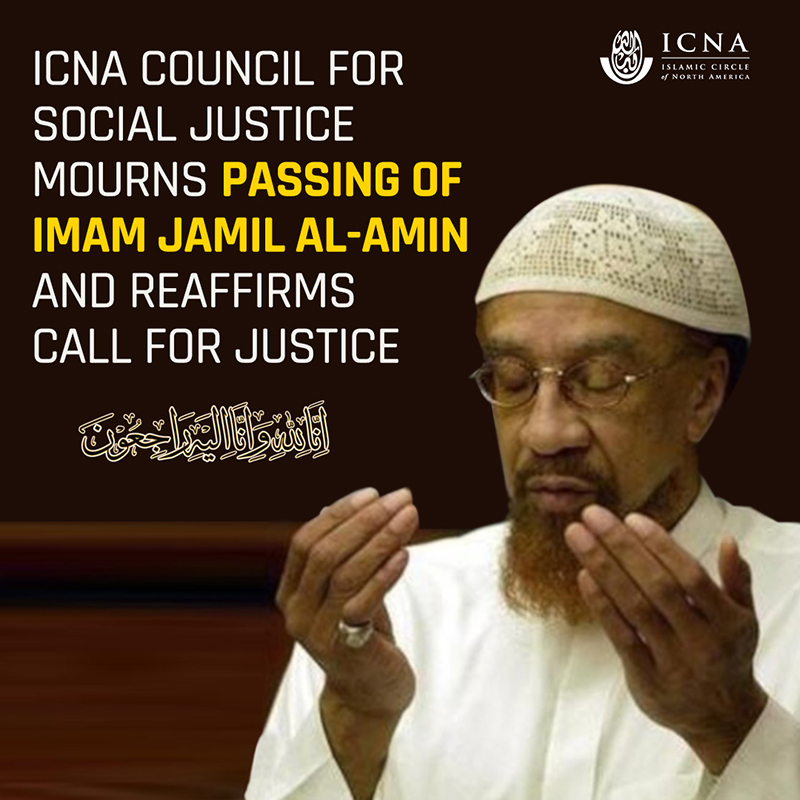
ICNA Council for Social Justice Mourns Passing of Imam Jamil Al‑Amin and Reaffirms Call for Justice

FOR IMMEDIATE RELEASE ICNA Council for Social Justice Mourns Passing of Imam Jamil Al‑Amin and Reaffirms Call for Justice The ICNA Council for Social Justice (ICNA CSJ), together with the Muslim Alliance for Black Lives (MABL), mourns the passing of Imam Jamil Abdullah Al‑Amin (formerly H. Rap Brown), who returned to his Lord on November 23, 2025, after decades of wrongful incarceration. We extend our deepest condolences to his wife, children, family, and Muslim community all who loved and were inspired by him. For more than six decades, Imam Jamil stood at the heart of the Black freedom struggle in America, from his early leadership in the Student Non‑Violent Coordinating Committee (SNCC) and his role as Minister of Justice of the Black Panther Party, to his transformative work as an imam in Atlanta’s West End. He helped build masajid, reduce crime, and revive a community through daʿwah, service, and principled organizing. ICNA CSJ has long affirmed that Imam Jamil was a political prisoner, targeted for his beliefs and community leadership rather than any crime. In August 1995, he was arrested in Atlanta on highly publicized shooting allegations; the alleged victim later stated he had been pressured to name Imam Jamil and admitted he never saw the shooter. Those charges were ultimately dropped. Years later, the same pattern of suspicion and overreach reappeared in the tragic events surrounding the shooting of two Fulton County deputies on March 16, 2000, for which Imam Jamil was convicted in 2002 and sentenced to life without parole. “We believe Imam Jamil’s conviction was a grave miscarriage of justice and part of a longer history of state repression against Black freedom fighters and Muslim leaders,” said Imam Khalid Griggs, ICNA CSJ. “His passing does not end our responsibility to seek truth, accountability, and restoration of his honor.” After his conviction, Imam Jamil was held for years in harsh federal facilities far from his family and community, including extended isolation and prolonged medical neglect. Even as his health deteriorated with serious illnesses, he remained a teacher, a source of strength, and a symbol of steadfastness for movements against racism, Islamophobia, and mass incarceration. ICNA CSJ and MABL honor Imam Jamil’s lifelong struggle for justice and renew our commitment to: -Support efforts to fully review and publicly disclose all evidence in his case; -Pursue posthumous measures to clear his name; -Stand with other political prisoners and victims of wrongful convictions, especially Black and Muslim prisoners. Inna lillāhi wa inna ilayhi rājiʿūn (From Allah we Belong and to Allah we shall return). May Allah grant Imam Jamil the highest ranks of Jannah, forgive his shortcomings, and reward his family for their immense patience and sacrifice. Media Contact: Imam Khalid Griggs ICNA Council for Social Justice

Read More »

Juneteenth: A Muslim Commitment to Justice and Liberation

Dear Brothers and Sisters, Assalamu Alaikum Wa Rahmatullahi Wa Barakatuh, As we mark Juneteenth, June 19th, as a federal holiday in the United States, it is important for us as Muslims to pause, reflect, and act. Juneteenth commemorates the day in 1865 when the last enslaved African Americans in Galveston, Texas, were informed of their freedom, two and a half years after the Emancipation Proclamation had been signed. It is a day rooted in the painful history of slavery, yet one that affirms the resilience, dignity, and contributions of African Americans in the ongoing struggle for justice and liberation. As Muslims, we are called by our faith to stand firmly for justice, even if it be against ourselves or those close to us (Qur’an 4:135). Commemorating Juneteenth is not simply an act of historical remembrance, it is an active commitment to recognizing and supporting the continued fight for Black liberation in America and beyond. This day reminds us not only of what has passed but of the continuing struggles many communities still face today. Let us commemorate this day through: ● Learning: Study and teach the history of Juneteenth, slavery, and systemic racism. Assign this as a topic in your weekly Neighbor Nets (Halaqahs/Usras). ● Volunteering: Support your local Inner City Empowerment Center. Dedicate time this weekend to service. ● Honoring: Recognize the legacy of African American Muslims and their foundational role in American Islam and justice movements. ● Observing: Reflect on Juneteenth through prayer, family discussion, community events, and educational forums. ● Connecting: Draw parallels between the African American struggle and global justice movements, including the plight of Palestinians and other oppressed peoples. Indeed, Juneteenth is not complete without acknowledging and committing to the liberation of all oppressed peoples. The legacies of slavery, colonialism, and occupation are not confined by national borders nor consigned to the past; they persist today through systems like the prison-industrial complex, where mass incarceration and forced labor disproportionately impact Black communities. Whether in the American South or the occupied Gaza and West Bank, we see parallel patterns of dispossession, systemic violence, and resistance. One of the painful intersections is the controversial practice of U.S. law enforcement receiving training from Israeli military forces. Indeed, these exchanges risk normalizing aggressive tactics used in occupation contexts and will contribute to increased militarization and police brutality within marginalized communities in the United States, especially Black and Brown neighborhoods. In this light, Juneteenth is not just a historical milestone, it is a call to action. A reminder that while slavery may have been formally abolished, the fight against racism, state violence, and systemic oppression continues. As Muslims, we must be allies in that fight. As Muslims, we are called to act, not merely in word, but through meaningful commitment and service to justice. Let us honor Juneteenth by committing ourselves to building a society, and a world, rooted in justice, equity, and compassion. Let us stand with the oppressed, support the marginalized, and lift the legacy of those who struggled before us. May Allah (SWT) guide us in this pursuit and accept our efforts. Sincerely, Salman Y. M. Secretary General Islamic Circle of North America

Read More »

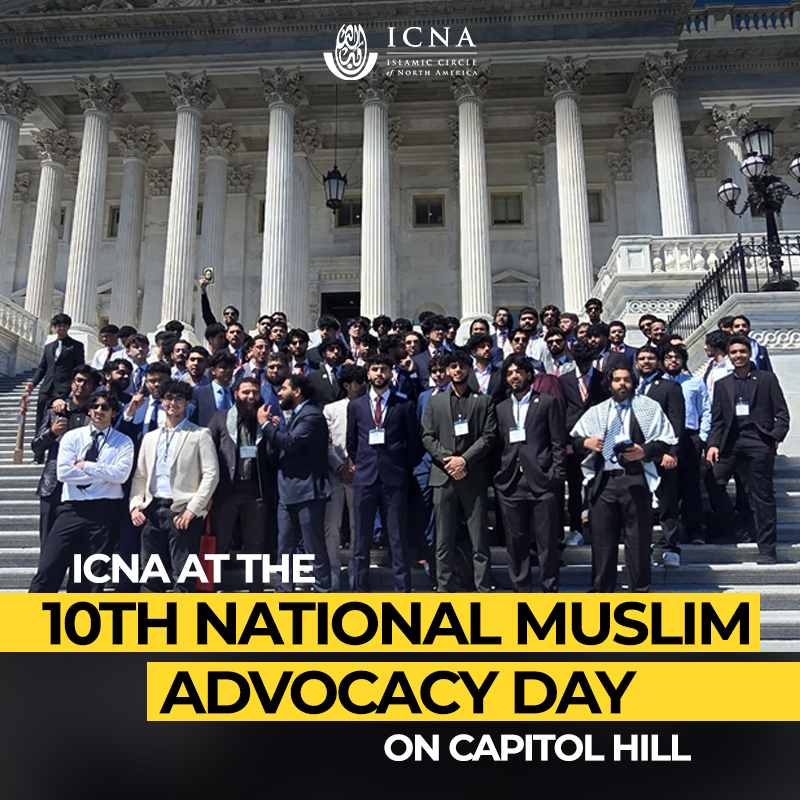
ICNA at the 10th National Muslim Advocacy Day on Capitol Hill

Alhamdulillah, ICNA marked a historic presence at the 10th Annual National Muslim Advocacy Day on Capitol Hill, hosted by the U.S. Council of Muslim Organizations (USCMO). This milestone event brought together Muslim leaders, activists, and constituents from across the nation to engage directly with members of Congress on pressing domestic and international issues. Under the theme “Defending Rights, Shaping Policy,” the 2025 National Muslim Advocacy Days centered on urgent and timely issues—including the protection of free speech, safeguarding students and campuses from threats and intimidation, defending civil rights and religious freedoms, and responding to grave humanitarian crises in Gaza and Sudan, as well as the ongoing persecution of Uyghur Muslims in China. The event powerfully underscored the critical need for the American Muslim community to hold elected officials accountable and to remain actively engaged in shaping national policy. ICNA’s delegation was the largest in the country, with nearly 325 registrants from 19 states, including nearly 200 dynamic youth and young adults from Young Muslims (YM). ICNA Sisters were also prominently represented, led by Sr. Sumaira, showcasing ICNA’s commitment to fostering inclusive civic participation. At the Capitol Hill evening reception, ICNA was honored as the top participating organization with the highest number of attendees. ICNA President Br. Saad Kazmi graciously invited Br. Ammar Siddiqui from Young Muslims to accept the award on behalf of the movement. The recognition highlighted ICNA’s strong grassroots infrastructure and the youth organizations growing role in national advocacy. Prominent guests included Congresswomen Rashida Tlaib, Ilhan Omar, and Latifa Simmons, along with leaders from major national Muslim organizations. Their attendance served as a reminder of the increasing visibility and impact of American Muslims in the civic and political spheres. Logistics for ICNA’s participation—including webinar-based training, hotel accommodations, transportation, meals, meeting schedules, and event coordination—were expertly managed by the ICNA Council for Social Justice (CSJ) team. A special hotel-based evening session, also hosted by CSJ, brought together six ICNA Ameers: Dr. Talat Sultan, Br. Zahid Hussain, Br. Naeem Baig, Br. Javaid Siddiqi, Br. Mohsin Ansari, and Br. Saad Kazmi, alongside ICNA Sisters President Sr. Sumaira. This Advocacy Day continues a tradition that began in 2015 when USCMO first launched this initiative to connect Muslim communities with lawmakers and advance a legislative agenda rooted in equality, social justice, and religious freedom. It has since become a powerful platform for fostering lasting relationships between American Muslims and policymakers, promoting a more inclusive and just society for all. In follow-up, CSJ will conduct a survey of attendees to gather feedback, identify areas of improvement, and encourage continued local engagement in advocacy efforts across the country, In Shaa Allah. ICNA President Br. Saad Kazmi encouraged attendees to carry the energy and training from the Advocacy Days back to their cities and towns, urging them to continue the vital work of social justice and advocacy at the local level. With meticulous planning and broad community support, this year’s event was executed seamlessly. May Allah swt accept the efforts of all involved and allow us to build upon this momentum in the service of our Deen and country. Ameen.

Read More »

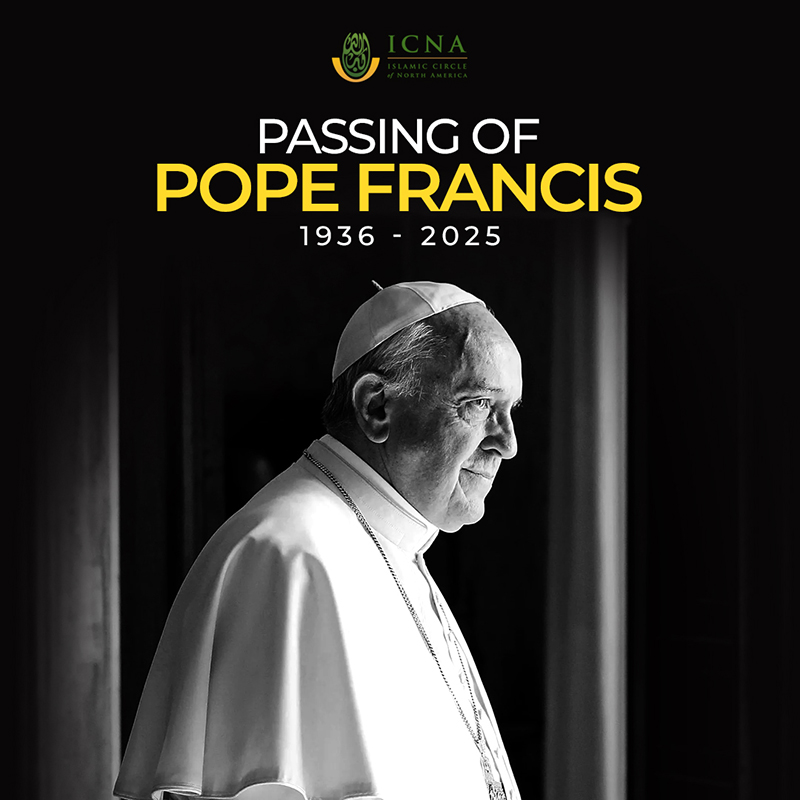
Passing of Pope Francis

All Praises are for Allah Lord of all that exists, and peace and blessings of Allah be on His final Messenger and his household. ICNA is deeply touched by the passing of Pope Francis, who departed this world following a brief illness. We extend our heartfelt condolences to our Catholic partners in interfaith dialogue (National Catholic-Muslim Dialogue), the global Catholic community, and all those around the world who are mourning his loss. Pope Francis was a symbol of humility, compassion, and bridge-building, and his absence will be deeply felt across faith traditions and communities committed to peace and justice. This was so evident from his simple life-style. His life exemplified humility and compassion, marked by an unwavering commitment to the service of humanity. Pope Francis dedicated himself to uplifting the marginalized, advocating for peace, and promoting justice across all borders. His deep yearning for a more peaceful world was powerfully reflected in his final public message, delivered just a day before his passing, in which he called for an immediate ceasefire in Gaza. In his emotional appeal, he described the situation there as both “dramatic and deplorable,” underscoring his enduring concern for human suffering and his moral leadership until the very end. Pope Francis stood as a moral beacon in a world so divided, yet he consistently advocated for peace, justice, and compassion for the marginalized—even in the face of criticism and adversity. His steadfast dedication to building bridges between faiths and promoting dialogue rooted in mutual respect left a lasting impact that transcended religious boundaries. Through his words and actions, he inspired hope and understanding, not only within the Christian world but across the global interfaith community. As Muslims, we recognize the value of righteous leadership and the importance of standing together in times of both joy and sorrow. Pope Francis’s legacy of empathy, simplicity, and advocacy for the downtrodden resonates deeply with our own Islamic values. We pray that God, the Most Merciful, brings comfort to those mourning his loss and may his efforts toward unity and compassion continue to inspire generations to come.

Read More »

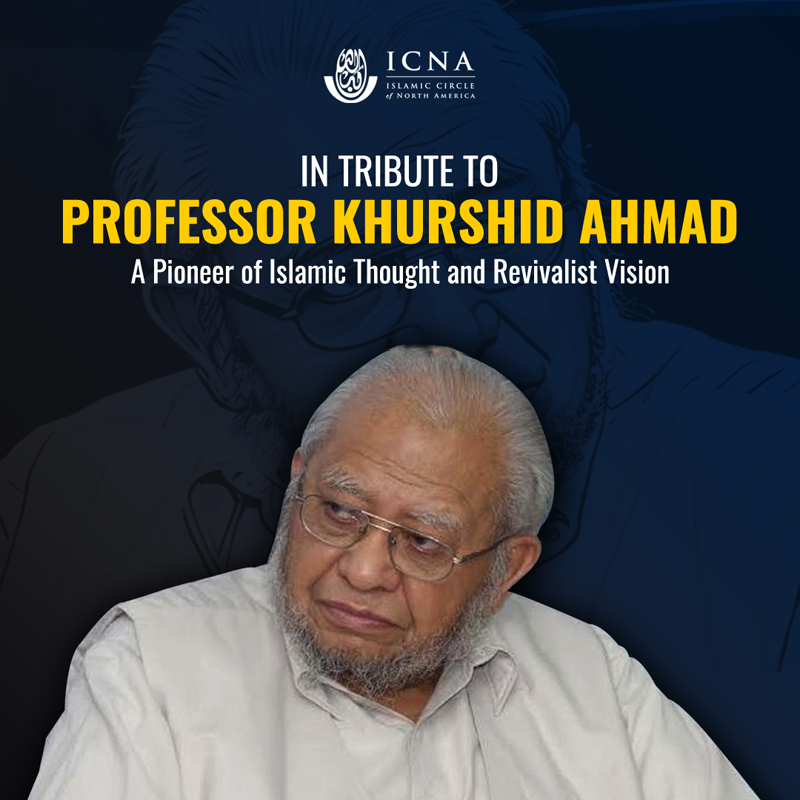
In Tribute to Professor Khurshid Ahmad

A Pioneer of Islamic Thought and Revivalist Vision “Among the believers are men who have been true to their covenant with Allah.” (Qur’an 33:23) It is with deep reverence that the Islamic Circle of North America (ICNA) mourns the passing of Professor Khurshid Ahmad (1932–2025), a distinguished scholar, visionary leader, and steadfast advocate for Islamic revival. His unwavering commitment to faith, intellect, and service has left an indelible mark on the global Muslim community. Born on March 23, 1932, in Delhi, Professor Ahmad migrated to Pakistan following the 1947 partition. He pursued his education with distinction, earning degrees in economics, law, and Islamic studies from Karachi University, and later completing a Ph.D. in Economics at the University of Leicester, focusing on Islamic economic jurisprudence. A pioneering figure in Islamic economics, Professor Ahmad co-founded the International Institute of Islamic Economics (IIIE) and played a pivotal role in establishing Islamic banking and finance as credible alternatives to conventional economic models. His scholarship emphasized the integration of Islamic principles into economic systems, advocating for justice, equity, and the eradication of exploitative practices. Beyond academia, Professor Ahmad was instrumental in shaping public policy in Pakistan. He served as the Federal Minister for Planning, Development & Statistics and as Deputy Chairman of the Planning Commission, where he worked to align national policies with Islamic values. His tenure in the Senate of Pakistan was marked by principled leadership and a commitment to the collective good of the Ummah. Professor Ahmad’s influence extended to the Western world, where he recognized the importance of building ideologically grounded Muslim communities. He co-founded The Islamic Foundation in Leicester, UK, fostering Islamic scholarship and education in Europe. His guidance and support were instrumental in the formation of ICNA, encouraging Muslims in North America to actively contribute to society while upholding Islamic values. A devoted disciple of Maulana Maududi, Professor Ahmad internalized and propagated the mission of Iqamat-ud-Deen—establishing Islam as a comprehensive way of life. He believed in Islam’s transformative power to address human suffering through its spiritual teachings and principles of justice and equality. Professor Ahmad’s life exemplified the ideals of servant leadership, humility, and unwavering dedication to the cause of Islam. His legacy serves as a roadmap for Muslims striving to fulfill their duties to Allah and society. We ask Allah (SWT) to shower His mercy upon Professor Khurshid Ahmad, forgive his shortcomings, accept his services, and grant him the highest place in Jannatul Firdaus. “Indeed, those who say, ‘Our Lord is Allah’ and then remain steadfast—on them the angels will descend, [saying], ‘Do not fear and do not grieve but receive good tidings of Paradise, which you were promised.’” (Qur’an 41:30) Islamic Circle of North America (ICNA) April 15, 2025

Read More »

Eid Mubarak 2025

As-Salāmu ʿAlaykum wa Rahmatullāhi wa Barakātuh, On behalf of the Islamic Circle of North America (ICNA), I extend heartfelt Eid greetings to you and your loved ones. May this blessed day bring peace, joy, and renewed faith into your life. May Allah (SWT) accept our prayers, fasting, charity, and every act of devotion we offered in His path. This Eid arrives during challenging times, as our hearts remain with the people of Gaza and others facing hardship around the world. Even as we celebrate, we remember them in our duas and remain committed to justice and compassion.https://www.youtube.com/shorts/56hou4hcQKc Eid is not just a celebration—it’s an expression of deep gratitude to Allah (SWT) for drawing us closer to Him. That gratitude is best shown through action: by spreading the message of Islam with compassion, helping those in need, standing up for the marginalized, and responding to injustice with goodness. ICNA is committed to building a better future for our communities and our children, inspired by the beautiful teachings of Islam. But we cannot do this alone—we need you. Whether it’s through Da’wah, Relief, Young Muslims (YM), or Social Justice initiatives, there is a meaningful role for everyone, regardless of age or background. The time to act is now! Visit icna.org, learn about our mission, sign up as a Friend of ICNA, and support this vital work with your time, talent, and money. Donate. May Allah (SWT) bless you and your family with peace, guidance, and His infinite mercy. Eid Mubarak! Saad Kazmi President Islamic Circle of North America – ICNA

Read More »

Celebrating Black History Month

Black History Month is an opportunity to recognize the contributions and impact of Muslims within the Black community in the U.S. The intersection of African American history and Islamic history contains many key aspects. Historical points of contact: Early Muslim presence in America There are accounts of Muslims arriving in America long before the United States existed. Some scholars record that as early as 889, a Muslim from Spain traveled across the Atlantic Ocean. In the early 1300s, King Abu Bakari I of Mali led an expedition to the Western Hemisphere. Evidence of this includes corn from the Mali empire discovered in Central and South America, as well as cave drawings in Arizona depicting dark-skinned people with elephants. Arrival of enslaved Muslims Between 10% and 30% of the more than 10 million enslaved Africans brought to the Americas between 1530 were believed to be Muslims. Many maintained their Islamic faith throughout their enslavement. Some examples of enslaved Muslims include Ayyub ibn Sulaiman Jallon (Job Ben Soloman), who was the first known Hafiz in America. Bilali Muhammad, was a plantation manager who built the first known Masjid on Sapelo Island in 1824. Omar ibn Said, was an educated Muslim who was captured and enslaved. Yarrow Mamout, an enslaved African Muslim, bought his own freedom and became a wealthy businessman. Revolutionary War African Muslims also fought alongside colonists during the Revolutionary War. Post-Civil War The presence of Muslims existed in the Civil War. For example, Nicholas Said served in the 55th U.S. Colored Infantry Regiment. https://www.youtube.com/watch?v=hQhHEfLlbzw 20th and 21st Century milestones: Recognition of Islam Thanks to WWII Veteran Abdullah Igram, Islam was recognized as an official religion in the U.S. military under President Eisenhower in 1952. Civil Rights Era During the Civil Rights Movement, many African Americans converted to Islam. Some notable figures include Malcolm X, who advocated for human rights. Also, Muhammad Ali, who refused induction into the U.S. Army citing religious reasons. Influence on Black Nationalism Duse Muhammad Ali and Marcus Garvey had a considerable impact upon Garvey’s movement. Under the leadership of Stokely Carmichael, SNCC was influenced more by the idea of Black Nationalism. Political Representation Charles Bilal became the first Muslim Mayor of a U.S. City. Keith Ellison was the first Muslim elected to the U.S. Congress. Andre Carson was the second Muslim elected to the U.S. Congress. Athletes Kareem Abdul-Jabbar converted to Islam. Hakeem Olajuwan founded the “Islamic Da’wah Center” in downtown Houston to help educate people about Islam. Ibtihaj Muhammed is a U.S.A. Bronze Medalist in the Team Saber event. Awards and Recognition Muhammed Ali became the 1st Muslim to receive the highest civilian award in 2005. Kareem Abdul-Jabbar was awarded the Presidential Medal of Freedom in 2016. Mahershala Ali won the Academy Award for Best Supporting Actor for “Moonlight” and “Greenbook”. Female Public Servants Some examples include Yaphett El-Amin, Jamilah Nasheed, Leticia Plummer, Deqa Dhalac.

Read More »

Transition in the Leadership of ICNA – ICNA, From a Dream to a Reality!

ICNA (Islamic Circle of North America), the largest and most active Muslim organization in the non-Muslim world, is progressing with new determination and leadership. Our beloved leader, and the outgoing president, Dr. Mohsin Ansari, handed over the charge to the new president, Saad Kazmi, who officially took the oath of the office on 1/25/25 infront of a heavily attended meeting of General Assembly held in Houston, Texas. During his farewell speech, Dr. Mohsin Ansari expressed gratitude to Allah SWT and extended his best wishes to the new president, urging all members to continue with sincerity, perseverance, and the spirit of sacrifice. https://youtu.be/JTwDLWYG_Qc In an emotionally charged environment, he invited and acknowledged senior and veteran ICNA members to the stage to honor their tireless efforts, selfless struggles, and the sacrifices. These remarkable individuals transformed ICNA into a “mighty tree” that now serves as a beacon of light and a center of hope for the Muslims worldwide. This moment reminds us that “leadership comes and goes, but the mission always remains.” The mission entrusted to us by Allah is the propagation of Islam, service to humanity, and unity of the Ummah, which we must collectively advance. ICNA has consistently worked day and night to address the challenges of American Muslims and the Ummah of our beloved Prophet PBUH, and remains committed to connecting future generations with the true message of Islam. We pray for the new president, Saad Kazmi, that Allah SWT grants him the wisdom, perseverance, and success, and that this caravan of Dawah and service continues to flourish. Allah says in the Quran:“And whoever helps the religion of Allah, Allah will surely help him and make him steadfast.” (Surah Muhammad: 7)

Read More »

Statement Condemning the New Orleans Attack

In the name of Allah, the Most Gracious, the Most Merciful. ICNA is deeply shocked and saddened by the heinous attack that has taken place in New Orleans. We extend our heartfelt condolences to the victims, their families, and the entire community affected by this senseless tragedy. Our thoughts and prayers are also with those injured, and we hope for their swift and complete recovery. As Muslims, we clearly condemn all acts of terrorism and violence, which have no place in our faith or humanity. Islam teaches compassion, justice, and the sanctity of life, and such actions are a direct violation of these principles as Allah SWT says: whoever kills a person, unless it is (in punishment by the authority) for murder or for spreading chaos in the land, then it is as if he has killed all of humanity. (Similarly), whoever saves a life, it is as if he has saved all humanity. (5:32) We also urge main stream media NOT to attack a faith due to actions of a deviated individual. There have been 488 mass shootings that took place in the USA in 2024. How many shooters were blamed for their acts because of their faith or lack of faith? Why did media not connect Brad Spafford of Virginia to his faith. FBI arrested this white man just two days back with 150 explosive devices. The Louisiana criminal is not an immigrant. He is a Texan army veteran of the Afghan war who was honorably discharged. ICNA also calls on people of all faiths and backgrounds to come together in unity and resilience against hatred and extremism in all its forms. We remain committed to fostering peace, understanding, and community support. Let this tragedy remind us all of the importance of rejecting division and embracing compassion and mutual respect. May we all work together to build a future, free of hate and violence!

Read More »

Related Categories

SUBSCRIBE
OUR NEWSLETTER