



When Role Models Fall from Grace

Laura El Alam Like so many converts, when I was a brand new Muslim, I was trusting and optimistic. Inspired by the beauty and perfection of Islam, I expected that all the “born Muslims” around me would be living upright, wholesome, pious lives. After all, they had been raised with Islam as their blueprint, and the Prophet (peace and blessings be upon him) as their role model. With the benefits of lifelong guidance and inspiration, I reasoned, how could they display anything but excellent behavior? I was so enamored with my newfound faith and so eager to think the best of my sisters and brothers in faith that I forgot about one inevitable reality: human weakness. Islam is perfect, but humans are not. In fact, every single one of us is a sinner. Anas ibn Malik reported: The Prophet, peace and blessings be upon him, said, “All of the children of Adam are sinners, and the best sinners are those who repent.” (Tirmidhī 2499) If you are a new convert, you may feel deep admiration for certain individuals who taught you about Islam. Perhaps it was your spouse, a co-worker, or a friend who introduced you to the faith. Maybe you started following a lecturer online because you were deeply impressed by their knowledge and charisma. Or possibly some congregants at the local mosque seem to be amazing people with outstanding character, and you’re thrilled to be in their presence. Having role models is not necessarily a bad thing, of course. A problem arises if we take our admiration a little too far. We sometimes put people on a pedestal, forgetting that they, too, are flawed human beings. We might start thinking of certain individuals as more than mentors and teachers, attaching our hearts to them, connecting our faith to them, and expecting them to be perfect. Then, when these people make mistakes or commit grave sins, it can be extremely painful. It might even shake the foundations of our iman, or belief in God. If we find ourselves feeling devastated or having a spiritual crisis when a beloved role model falls from grace, that is a sign that we have put too much emphasis on that person, and not enough on Allah and His deen. We probably did not intend to form an unhealthy attachment, nor set out to worship someone other than Allah. But if our disappointment in a fellow human being’s transgressions hurts us to our core, it is a clue that we have formed an unhealthy or inappropriate attachment to him or her. As Yasmin Mogahed explains, “Pain is a pointer to our attachments. That which makes us cry, that which causes us the most pain is where our false attachments lie. And it is those things which we are attached to as we should only be attached to Allah which become barriers on our path to God.” How can you cope with being shattered when your Muslim role model lets you down? Constantly remind yourself that only Allah is perfect. His prophets, the best of humanity, were infallible in regards to sin, but still mortal and fragile creations. Because humans have free will and are inherently flawed, we will all fall short of our faith’s high standards now and then. But our mistakes are not His mistakes, nor are they indicators that something is wrong with Islam. Continually refresh your personal connection with Allah, the Quran, and the Prophet (peace and blessings be upon him). We are all part of the Ummah, a community of brothers and sisters in faith who should support and protect one other. Bonding, interacting, studying, and worshiping with fellow Muslims is generally beneficial. But remember that in Islam, you don’t need an intercessor between you and God. You are already– and always– close to your Creator. He tells us in the Quran: “Indeed, it is We Who created humankind and fully know what their souls whisper to them, and We are closer to them than their jugular vein.” (50:16) Remember that tawheed, worshiping Allah alone, is Islam’s central and single most important concept. Always check the compass of your heart and make sure it is pointing towards Him alone. Don’t over-generalize. The human brain is predisposed to learn negative stereotypes, but remember that just because one individual does something disappointing or harmful does not mean that all Muslims are like that. For instance, in cases when a well-known Islamic scholar is exposed for his sins, people often begin to suspect or distrust all scholars. They may even over-generalize so much that they begin to doubt Islam itself. Be proactive to avoid unhealthy attachment in the first place. One step is to adhere to Islam’s gender segregation rules. There is great wisdom in enforcing a distance (both physical and emotional) between men and women who are not mahrams. One-on-one chats and lessons, whether in person or online, can easily devolve into flirtations or prohibited relationships. If you are seeking Islamic knowledge, it is best to find a teacher of the same gender. Learn Islamic knowledge from various sources. If all of your information comes from one person, you will be more dependent on him or her and more likely to suffer a huge spiritual blow if their sins are exposed. There are innumerable resources, online and in-person, to learn about Islam and plentiful scholars of both genders. So, diversify your learning. Allah created humans as social beings. We are predisposed to seeking meaningful connection with others, and our hearts can feel profound emotions. There is nothing wrong with loving and admiring people within the boundaries of Islam, but we must always remember that ours is a religion of moderation. We should strive to keep our hearts from feeling too attached to anything in this dunya (worldly life). After all, everyone and everything on Earth will eventually perish. The only permanent One is our Creator. He is the only one who will never, ever let us down and He is the only One worthy of our devotion. Read Other Articles on whysialm.org
Coming to Islam: Jana Hussain

Jana Hussain There is a saying of the Prophet Muhammad (may the blessings and peace of God be upon him), “Verily, the parable of good and bad company is that of a seller of musk and a blacksmith. The seller of musk will give you perfume. You will buy some, or you will notice a pleasant smell. As for the blacksmith, he will burn your clothes, or you will notice a bad smell” (Sahih Bukhari). Growing Up Far from Familial Support My parents moved from Iowa to California when I was two-years-old, leaving behind all their families. We moved again when I was nine, and my parents divorced when I was twelve. When I was sixteen, we moved again after my mother remarried. Needless to say, I did not make any long-term friends. Our family situation was very problematic. Children are very vulnerable to stress in the home, especially when there is no extended family—no grandparents, no aunts, no uncles, no cousins to have as support. The underlying family dynamics caused me to be not close at all to my father and not as close as I would have liked to my mother. I definitely had feelings of loneliness, with my only emotional support being my younger sister. My parents were mildly religious; they sent us to Sunday School for which I am grateful, as that gave me my strong belief in God and His Prophets, especially Jesus, whom I loved for his miracles and uplifting teachings. I did not think too much about the concept of the Trinity and the Nicene creed we occasionally recited in church. It never made much sense to me. I have always been a seeker. I once tried to build a crude altar out of rocks once like I imagined Jewish altars were, but I had no way to connect it back–no sunnah, or practice of the prophets, that outlined how it was done. Finding Emotional Stability & Islam I was not psychologically and emotionally strong, and I avoided controversies, especially about the nature of Jesus. My sense of self felt threatened, as I did not know what was true. I had a roommate from Mexicali in college and other Mexican/American female friends and went to Mexicali a few times to visit with my friend and her mother. For the first time in my life, I saw and was very attracted to close mother/daughter and female cousins’ bonds. It was the first time I had seen a strong extended family structure and realized how emotionally stabilizing it was. I became Catholic temporarily as I liked the campus Catholic services with guitar; it was not as attractive when I attended mass outside. I met my husband Manzoor in college at the International Club and was very attracted to his strong sense of family and his stable nature, born from his faith and solid family upbringing with lots of extended family. I was also drawn to his self-confidence about his direction in life. I did not know much of Islam but learned that Jesus is not considered the son of God. I did not think too deeply about it. When we considered marriage, I agreed that it was better for both parents to be on the same page, religion-wise. There were very few Muslims at that time at the university, so my main reference for Islam was my husband. At some point after marriage I got the book Islam in Focus, which I found very enlightening. One of the things that really impacted me was the fact that in Islam, there should be no separation between your faith and your treatment of human beings, even in the area of business. You had to be honest about whatever you were selling. My stepfather was a strong Christian, but he believed that you should give to God what belongs to God and to man what belongs to man (according to the Bible). In his belief, there was no problem not being transparent in business dealings which never made sense to me even when a Christian. I did not have any information for many years about the life of the Prophet (may the blessings and peace of God be upon him), unfortunately. The plan was for Manzoor and I to get married in my parents’ house with a Presbyterian minister and then later that evening for me to convert to Islam and get married in a masjid. To give you an idea of my state—it never occurred to me to tell my parents that I planned to become Muslim. My step-father found out the night before we got married and was extremely upset, as he felt I would be condemned to hell if I were not a Christian. My mother was less concerned. She was more worried about any prejudice our children might experience. After becoming Muslim, my husband and I moved a lot. We were in Iran, Austria, and Pakistan before finally settling back in the United States. In Iran, I fasted Ramadan for the first time and felt how fasting seemed to strengthen me internally and gave me a sense of peace. I was first introduced to mysticism or the spiritual aspect of Islam, sometimes called Sufism, and I found it very peaceful. Islam’s Emphasis on the Inward and Outward After we finally returned to the United States, I strove harder in my goals to attain closeness to God. My spiritual teachers always advised to begin gradually and then take on more and more practices as was comfortable and natural. This is especially important to remember. When a person first embraces Islam or even initially makes the decision to practice more, it can feel burdensome and overwhelming. Begin slowly and implement good habits like daily Quran recitation, supplication at particular prayer times, and sending blessings on the Prophet (may the blessings and peace of God be upon him). The key point stressed is consistency—it is better for the soul’s development to do a little every day than to do a lot
Witnesses to Genocide

Some events that occurred on specific dates are so embedded into the collective consciousness of the American people that each calendar year, we recall how our individual and national consciousness was impacted. Usually, such occurrences take place on American soil, like the 911 bombing of the World Trade Center’s twin towers or the January 6th insurrection attempt to block the certification of the winner of the 2020 Presidential election. But, on October 7, 2023, Hamas, The Islamic Resistance Movement in Occupied Palestine, launched coordinated operations on a music festival attended by hundreds of youths and on multiple Israeli kibbutz. These actions resulted in around 251 Israelis being taken as hostages. Western media reports of mass rapes of Israeli women and the beheading of infants were later proved to lack evidence, truth, or credibility. Shortly after the hostages were taken, Israeli Prime Minister Benjamin Netanyahu set into motion one of the most brutal genocidal assaults against non-combatants, primarily women and children, ever witnessed in the 21st century. Hundreds of thousands of Israelis were protesting in the streets for the ouster of Netanyahu on charges of corruption before the Hamas attack. The political calculus of his situation was to ignite a long-term military conflict in the region to stave off being unseated as Prime Minister and going to jail. The response of the United States to the Israeli bombing of Palestinian homes, schools, and hospitals and the destruction of the entire infrastructure of the Gaza Strip was to replenish their stockpile of 2,000-pound bunker-busting bombs, rockets, and other weapons of war against a defenseless civilian population disproportionately comprised of women and children. To date, at least 175 courageous Palestinian journalists have been illegally targeted and killed while daring to report and film the unprecedented orgy of slaughter against an innocent Palestinian population. The United States has a complicated relationship with the state of Israel that goes far beyond that of merely being an ally. Israel has served as a cat’s paw for American and European interests, particularly oil and other resources found in the region. However, some European and Asian allies of the United States are confounded by its seemingly uncritical support of the present and past governments of Israel’s crimes against humanity committed against the Muslim population of Palestine and the region. A critical understanding of the essential elements that have seemingly inextricably bound the fate of the United States to the Zionist state of Israel is in order. In the book, Israel, America’s Key to Survival, by Mike Evan’s, the author writes, “Only one nation, Israel, stands between terrorist aggression and the complete decline of the United States as a democratic world power…If Israel fails, the United States can no longer remain a democracy…Arab money is being used to control and influence major U.S. Corporations, making it economically more and more difficult for the United States to stand against world terrorism.” In addition to being a questionable, if not outright false, assertion, the statement ignores the actual power dynamics of the two states in which the destructive military capacity of the United States coupled with its financial strength compared to other nations act as significant deterrents for other nations to attack Israel physically. Also, the US’s absolute support of Israel in world bodies like the United Nations militates against any attempt to sanction Israel. The book’s premise is a classic case of the tail wagging the dog. The phrase “the tail wagging the dog” describes a situation where a more minor or less significant part of something controls or influences the whole inappropriately or unexpectedly. The powerful lobby for Israel AIPAC, the American Israel Public Affairs Committee, has additionally enhanced Israel’s status in the United States. AIPAC speaks and raises money on behalf of a coalition of pro-Israel American Jewish groups. Factually speaking, few US Senators and Congresspeople do not receive donations from AIPAC. In exchange for AIPAC’s donations, the expectation is for the recipients to vote in favor or against legislation as instructed by AIPAC. However, donations from lobbyists are not the sole contributing factor to Israel’s outsized influence over America’s domestic and foreign policy. The ever-growing presence of Christian Zionists across the United States has an out-sized impact on why Americans accept the extreme political and military behavior of the Zionist State of Israel against the Arab, mainly Muslim, countries and within Occupied Palestine, and on the African continent. According to a Pew Research 2023 study, 63 percent of Americans identify as Christians, the largest denomination being Catholics, followed by Evangelical Protestantism. Evangelical Protestants are among the fastest-growing Christian denominations in the United States today. Christian Zionism is a belief among some Christians that the return of the Jewish people to the Holy Land, modern-day Israel, and the establishment of the State of Israel in 1948 are following Biblical prophecy. This movement supports the political and religious alliance between Christians and Jews, particularly in favor of the modern state of Israel. Christian Zionists advocate for policies that unilaterally favor Israel’s security and sovereignty at all costs, often influencing political decisions in the United States. The current President of the United States has emphatically stated that he is a self-avowed Christian Zionist. Maybe this helps us to understand why he is facilitating genocide while professing to be a faithful Christian. Since the establishment of the secular Zionist state of Israel, Biden and American Presidents before him have assisted the Israeli devastation of Palestinian Muslim populations and forced removal from their homes. Like Biden, Christian American Presidents, as one of the first overseas acts of their Presidency, have put a yamaka on their heads and bowed their heads at the Wailing Wall in Occupied Jerusalem. The carnage that we have seen in Occupied Palestine since October 7, 2023 could not have happened without the tacit support of Christian Zionists in the US. As witnesses to a horrific, indisputable genocide being brought to us by social media, selective mainstream accounts, and brave Palestinian journalists, we must do our part to influence an authentic narrative
The Prophetic Way to a Fulfilling Life: Incorporating Gratitude into Your Daily Practice

The Power of Gratitude: How Islamic Prayer Can Improve Your Day Islam is a religion that emphasizes the importance of remembrance of God in all aspects of life. The Prophet Muhammad, peace be upon him, used to say a prayer on almost every occasion such as eating, drinking, sleeping, traveling, and entering one’s home. This article will highlight the psychological and mental benefits of one such supplication, the one recited when one wakes up. Islamic Prayer Upon Waking: A Reminder of Death and Resurrection Muslims are encouraged to begin each day with a prayer that says “All thanks are due to God who gave us life after death and to Him is the resurrection.” (Sahih Bukhari). This prayer highlights the importance of recognizing that sleep is a form of temporary death and that waking up in the morning is a new lease on life. It also reminds us of the ultimate reality of death and resurrection, and how every day is a rehearsal for the day of judgment. What is similarly important is that it encourages Muslims to start the day with a prayer of gratitude. The first words that are uttered upon waking up, when one’s eyes are barely open, is “Thanks to God.” This has a tremendous impact on one’s psychology. It sets the tone for the rest of the day and helps to cultivate a positive mindset. Gratitude is a powerful psychological tool that has been shown to improve well-being, increase resilience, and enhance interpersonal relationships. How Gratitude Can Better Your Mental and Physical Health Research has shown that practicing gratitude can increase levels of dopamine and serotonin in the brain, which are neurotransmitters associated with feelings of pleasure and happiness. Gratitude can also reduce levels of cortisol, the stress hormone, which is associated with a range of negative health outcomes, including anxiety and depression. Gratefulness is an antidote to negative emotions such as anxiety, depression, and stress. When we express gratitude, we shift our attention from what we lack to what we have, and this shift in mindset can have a powerful effect on our overall outlook on life. Grateful people are more optimistic, have better relationships, and are more resilient in the face of adversity. Gratitude and Patience: The Keys to a Happy Life The reality is that everyone has some kind of problem in their life. When we wake up, we often think of what we have to do that day or the challenge we have to overcome. However, Islam teaches us to be grateful not just for the blessings we receive, but also for the challenges and difficulties we face. The Prophet Muhammad, peace be upon him, said, “How wonderful is the affair of the believer, for his affairs are all good, and this applies to no one but the believer. If something good happens to him, he is thankful for it and that is good for him. If something bad happens to him, he bears it with patience, and that is good for him.” (Sahih Muslim) Gratitude and patience are important in all circumstances, whether they are good or bad. It reminds us that challenges are opportunities for growth and development and that even in difficult times, there is always something to be grateful for, even things we often take for granted, such as the fact that we wake up each day. Practicing Gratitude Regularly Can Lead to a More Meaningful Existence Starting the day with a prayer of gratitude is an important practice in Islam that has both psychological and spiritual benefits. It reminds us of the temporary nature of life and the ultimate reality of death and resurrection. It also helps to cultivate a positive mindset and increase feelings of happiness and well-being. Gratitude is a powerful tool that can be used to enhance all areas of our lives, and practicing it regularly can lead to a more fulfilling and meaningful existence. The Prophet Muhammad’s Teachings on the Purpose of Life Ultimately, the teachings of the Prophet Muhammad, peace be upon him, are full of wisdom that has real-world benefits. The act of sleeping and waking up is a rehearsal for the Day of resurrection. It is a mini death and resurrection every day. This prayer reminds Muslims of the ultimate purpose of life. It is a reminder that all humans are accountable for their actions and that they should strive to do good and avoid evil. This awareness can help people make better decisions throughout the day and align their actions with higher moral values. All of Islam’s teachings are meant to bring good and ward off bad from the lives of humans. It is only through Islam that one experiences actual peace, tranquility, and serenity. Have more questions? Call 877-WhyIslam, you deserve to know! Read Other Articles on whysialm.org
The Tremendous Harms of Pornography to Adults and Youth

In an otherwise normal, decent world, pornography is not a topic that we would wish to publicly discuss. Talking about issues with negative connotations often brings out the very destructive impact on the public that we intended to avoid. But once a destructive issue is already in the public sphere and impacting society, it is important to discuss it. The case of pornography in the West and most countries in the world is exactly that—it’s way past the threshold. In fact, it’s wreaking havoc in society. Pornography has manifested in its most extreme state of vulgarity in our current time, using the omnipresent technology of the internet and mobile devices. Pornography has always been a part of human culture, going at least as far back as the fertility cults, with their pornographic drawings, that existed throughout the world. Some researchers suggest that fertility symbols were used as early as prehistoric times. The digital age has given pornography new dimensions and raised concerns about its negative impact on individuals and society as a whole. It’s just like “sugar” in the modern diet causing a public health disaster, it’s omnipresent—you don’t need to seek sugary products explicitly, but added sugar comes to you in every food you buy, be it kids’ milk pouches, juice, bread, ketchup… you name it. Similarly, pornography or the likes of it doesn’t need to be sought explicitly but comes to you as an ingredient in your everyday life—you go to a TV channel, a web page, YouTube, or internet gaming sites—you constantly get baited or even sampled (sampling is a direct marketing technique that offers the consumer a small sample for free so that they will be motivated to purchase the full product after that). Baiting is most often done with soft porn, a gateway to more hardcore pornography. According to definitions.net, softcore pornography is… “…commercial still photography or film that has a pornographic or erotic component but is less sexually graphic and intrusive than hardcore pornography, defined by a lack of visual sexual penetration. Softcore pornography includes stripteases, lingerie modeling, simulated sex and emphasis on the sensual appreciation of the human form. It typically contains nude or semi-nude actors involved in love scenes and is intended to be sexually arousing and aesthetically beautiful. The distinction between softcore pornography and erotic photography is largely a matter of taste.” Islamic Clarity About Pornography For Muslims, there is no distinction between soft- and hardcore porn. Islam is clear on the issue of producing or consuming sexually explicit material of any kind. It hasn’t just declared it unacceptable but creates barriers surrounding it so that society can prevent individuals coming close to it. Islam is the religion of haya, modesty. In that way, Islam provides, so to speak, a natural immunity to pornography. So, we shouldn’t be worried, right? Far from it. This danger is like an infectious virus—indiscriminately attacking Muslims and non-Muslims alike. We’ll go over why the Muslim “immune system” to pornography isn’t working. Let’s understand first the “immune system,” if you will, that’s inbuilt in Islam. Islam has put modesty of men and women as a criterion of faith. It’s not just about wearing modest outfits and restricting the mixing of men and women; it is also a lowering of the gaze by both men and women. Islam accepts the reality of human biology that drives us sexually. Thus, Islam puts marriage as a top priority to channel sexual impulses in a healthy and productive way. The Qur’an is very clear on every able man and woman getting married unless there’s a condition of prohibitive disability or abject economic hardship where they are advised by God to “fast” to counter the effect of human biology and hormones. The Qur’an then takes it to the next level: advising men and women to not even come close to sexual involvement outside of marriage—knowing that humans are created weak and that one must stay away from the slippery slope of immoral activities. At a societal level, the Islamic economy has made it very explicit that anything harmful to society shouldn’t be a money-making industry. Alcohol, drugs, gambling, pornography, etc., are prohibited in the Islamic system. That’s a macro-level immunity that Islam provides. One should then ask why all the above aspects of such a broad-based defense mechanism is not working for Muslims. The answer is simple — we’re living in a society that promotes a lifestyle that compromises the “immunity” that we are supposed to have. Do not think that it’s only in America or in the West. It’s also ubiquitous in many Muslim countries as most of the world is now following the West as a cultural role model without giving any critical thought to religion or societal stability and well-being. Pornography is a legal business in most countries. Some may deny that Muslim countries have such an industry. I would argue, however, that the entertainment industry is not far removed from it, and most Muslim countries allow the almost unrestricted flow of Hollywood or Bollywood movies. As mentioned above, soft porn, which is prevalent in movies, is just one step from more hardcore pornographic material. To make the effect worse, marriage between a man and a woman is being hollowed out, while the uncensored mixing of men and women is encouraged or, many times, structurally necessary in the workplace. Harming of Faith and Healthy Relationships The most devastating harm pornography or the entertainment industry does is that they eat away the foundation of the faith (iman). Imam Ghazzali wrote in his book Minhajul Abedin that if our nafs (self, soul) is a wild beast that drags us to follow our desires, then the gates through which it’s fed are through our senses. The most important sense is our eyes. The more the beast is fed, the wilder it becomes. And it drags you further away from the remembrance of Allah. It’s like a rain shower on a barren land with a downward slope—you put soil on it to farm crops, but the
Imam William ICNA Statement
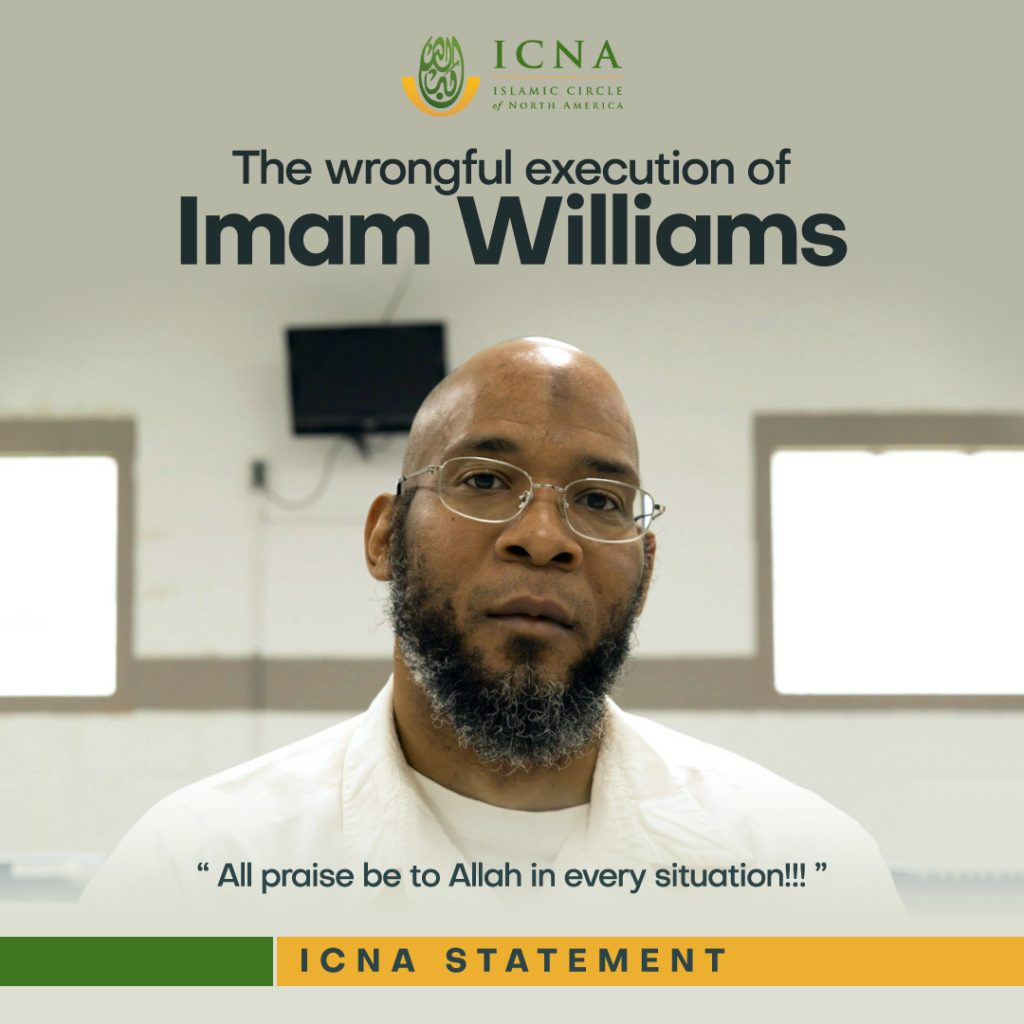
All Praise be to Allah in every situation! These were the last words of Br. Mercellus Williams is also known as Imaam Khalifah. His execution was carried out yesterday, Tuesday, September 24, 2024, at a prison in Bonne Terre in Missouri, despite objections from the victim’s family and prosecutors who sought to have his conviction overturned. ICNA reiterates that execution of an individual without fulfilling all the legal requirements and evidences is the ultimate miscarriage of justice. If there is a possibility of error, Islamic jurisprudence leans toward mercy and leniency. The emphasis is on protecting life rather than risking the potential for injustice. In Islam, the principle of avoiding the death penalty in the presence of doubt is rooted in the value of justice and mercy. This principle is well known in the Books of Fiqh “Avoid applying the hudud (prescribed punishments) in cases of doubt”; This emphasizes that if there is any uncertainty regarding the guilt of the accused, the death penalty should not be applied. In this case in question, there were several areas of doubt and uncertainty, including the most powerful evidence; the DNA that concluded that the evidence found did not match that of Imaam Khalifah. Yet there was this urge to carry out this execution. One wonders why! The problem is that here in the USA, we claim to be champions of human rights, especially when criticizing others, but fail to uphold those same principles in our own practices. This contradiction between words and actions weakens not only our moral authority but undermines public confidence in the judicial and legal systems. Words and actions do not match! ICNA offers condolences to the family, friends and community of Imaam Khalifa and call on the Muslim Community and people of conscience to ensure that such injustices do not happen again on our soil and for this, we have a lot of work to do. May Allah SWT bless our dear Imaam and grant him Jannatul Firdous. All Praise be to Allah in every situation!
USCMO Condemns Israeli Attacks on Civilians in Lebanon, Calls for U.S. to Force Gaza Ceasefire

(Washington, D.C., 9/24/2024) – The US Council of Muslim Organizations (USCMO) – the nation’s umbrella group of national, regional, and local Muslim associations – strongly condemns the Israeli government’s expansion of its genocide in Gaza and ethnic cleansing in the West Bank to an indiscriminate mass bombing campaign against civilians in Lebanon. USCMO also called on the Biden administration to stop the Israeli government’s attempts to drag the U.S. into an all-out war by forcing a ceasefire in Gaza. In a statement, USCMO Secretary-General Oussama Jammal said: “USCMO strongly condemns the Israeli government’s indiscriminate bombing of civilians in Lebanon and calls on the Biden administration to end American military and financial support until the out-of-control Netanyahu government accepts a permanent ceasefire in Gaza, completely withdraws from Gaza, and ceases its indiscriminate war on the people of Lebanon. We pray God protects the innocent peoples of the Middle East and saves the region from more death and destruction paid for with American taxpayer dollars.” The Israeli indiscriminate bombardment of Lebanon today – exclusively targeting heavily populated civilian centers – bears the monstrous hallmark of Israeli military doctrine of deliberately attacking civilians. Here are the horrors it wreaked (with its U.S.-made weaponry) on Lebanon’s population in just hours today: ➟ 35 Children Killed ➟ 39 Women Killed ➟ 492 Civilians Killed ➟ 2 Medics Killed ➟ 1,246 Seriously Wounded That means in less than a week, the Israeli military’s civilian-killing war machine has deliberately obliterated more than 500 innocent lives. This is Israeli military doctrine. Giora Eiland, former military head of the Israeli National Security Council and head of IDF Planning, recently articulated this publically, justifying his plan for the complete ethnic cleansing and total siege of northern Gaza: “The slogan that ‘only military pressure will bring victory’ has no basis whatsoever. The wars of the 21st century are based on something else. The most important parameter is [targeting] the population, and those who can control the population win the war,” he said. “You [have to] take away both [the population’s] land and dignity.” USCMO condemns Israeli aggression into Lebanon and its doctrine of targeting civilians. It calls on the Biden administration to publically make clear the U.S. will not support or engage in Israeli wars in the Middle East. USCMO calls for an immediate U.S. Israeli arms embargo and a cessation of all American military and financial support until the Israelis have accepted a permanent ceasefire in Gaza, completely withdrawn from Gaza, and ceased its aggression against Lebanon. We pray that God protects the innocent peoples of the Middle East and saves the region from war.
Laying the Foundation for The Ummah
Allah SWT has sent about 124,000 Prophets and Messengers throughout history but there is something special about Rasoolullah (peace be upon him). All previous Prophets came only to preach to their particular nation primarily, or to their specific tribe, but Rasoolullah (pbuh) came with the Message to all of mankind, until the end of time. Allah SWT says, “We have not sent you [O Muhammad] except as a messenger of good news and a warner to all people, but most people do not know” (Qur’an 34:28). Further, at the end of a long Hadith narrated by Jabir bin Abdullah (r), Rasoolullah (pbuh) said, “… Every Prophet used to be sent to his nation only, but I have been sent to all mankind” (al-Bukhari). Since Prophet Muhammad (pbuh) was sent to all humanity, then as his true followers, we are required to spread the Message by utmost sincerity and effort because no more Prophets or Messengers will be sent, and this Divine Message must be delivered. Yes! As Ahlus Sunnah wal Jamaa’ah [the people of the Sunnah and the Community who unite upon it], we do believe that in the end times, Prophet Jesus (a.s.) will be coming back, but he will not be coming with anything new. In fact, he will be following the Shari’ah of Muhammad (pbuh). Not judged by results Let us be clear that we will not be judged on the results in delivering this Message but on our efforts; the result is in the hands of Allah SWT. Today it seems that Da’wah revolves around numbers and speakers. In the Ahaadith it is reported in both Imaam al-Bukhari and Imaam Muslim that Rasoolullah (pbuh) said: “The nations were shown to me, and one or two Prophets would pass by me with a group [of followers], and a Prophet who had no one with him.” It is also narrated by at-Tirmidhi and an-Nasaa’i from Ibn ‘Abbaas, who said, “When the Prophet (pbuh) was taken on the Night Journey [Isra’ and Me’raj], one or two Prophets would pass by him who had a community with them, and one or two Prophets who had a small group with them, and one or two Prophets who had no one with them, until he passed by a great multitude…” Yet, all these Prophets carried out their responsibilities in delivering the message of Tawheed (The Oneness and Uniqueness of Allah SWT) to their people and preached against anything their people worshipped besides Allah. So, we have to go out and deliver the Message of the deen. And we do so with the wisdom and the methodology shown to us by Rasoolullah (pbuh). Allah SWT commands, “Invite to the way of your Lord with wisdom and good advice, and reason with them in a way that is best. Indeed, your Lord knows best who has strayed from His path, and He knows best who is guided” (Qur’an 16:125). Dear brothers and sisters — living as a minority here in the U.S., we have this responsibility to deliver the true Message to both Muslims and non-Muslims. The freedom of assembly and speech we have may not last for long, and we will be held accountable for the opportunities Allah SWT gives us to share this Message. The question we should constantly ask ourselves it this: “Did we fulfill our responsibility in delivering this Message as commanded by Allah SWT and His Messenger?” In fact, we should deliver the Message to the fullest extent of our ability, even if our ability is very limited, as Rasoolullah (pbuh) said in a hadith narrated by ‘Abd-Allaah ibn ‘Amr (RA): “Convey from me, even if it is one verse.” Al-Haafiz ibn Hajar (may Allah’s mercy be upon him) said in his book, Fath al-Baari: about this Hadith: “’Even if it is one verse’ means that everyone who heard him (pbuh) would hasten to convey whatever he heard of the verses, even if it was very little, so that in this manner everything that he (pbuh) brought would be conveyed.” Another scholar explains this Hadith in the following way: “If a person understands what he is calling people to, it makes no difference whether he is a great and prominent scholar or a seeker of knowledge who is serious in his pursuit thereof, or a regular person who has certain knowledge of the issue in question. The Messenger (pbuh) said, ’Convey from me, even if it is one verse,’ and he did not stipulate that the Daa’iyah [one who invites to Islam] should have reached a high level of knowledge, but it is essential that he should have knowledge of that to which he is calling people. But calling out of ignorance or calling based on emotion is not permissible.” Read Other Articles on Message International How should we deliver this message of Islam to people? First, it is important to connect with the people as Rasoolullah (pbuh) did for 40 years of his life before receiving revelation. If we just give speeches to the people and do not interact with them, allowing them to know who we are, what our beliefs, attitudes, and behaviors are in everyday and commonplace ways, then they are not very likely to give full attention to lectures, or be moved or inspired by them. Secondly, we should stand for justice for everyone in society. We know when Rasoolullah (pbuh) was given the news of his Prophethood by Angel Jibreel (a.s.), he went home and told Khadija (r) what had happened and expressed some worries about his experience. She told him, “Never! By Allah, Allah will never disgrace you. You keep good relations with your kin, help the poor and help the needy, serve your guests generously, and assist those afflicted by calamity.” Note that Khadija (r) described his virtuous behavior that he was known for before he had begun his mission as a Prophet. So, if we help other people in their social and economic affairs, in taking care of their needs, it opens the
Seerah Reflections: The Most Painful Day for Prophet Muhammad
When reading the biography of Prophet Muhammad (peace be upon him), we find many examples of him enduring pain, abuse, persecution, opposition, and injustice in various forms. But what was the most difficult day of all? And how does reflecting on his painful experiences help us better understand his life and legacy? Studying the Prophet’s pain allows us to better appreciate his prophethood, his humanity, and the immense sacrifices he made. It enables us to more deeply value the final message of God, conveyed by the last messenger to humankind, and to feel gratitude for the opportunity to worship Allah and experience purpose and salvation through following His final message. As believers engage in discussions over secondary or minor issues within Islam, it would benefit us all to study the most challenging moments of the Prophet’s life (pbuh) in order to better understand the weight of the responsibility that comes with following him. One might consider the pain of the Makkan boycott, the torture of his followers, the death of his beloved wife Khadijah and his uncle Abu Talib in the same year (known as the Year of Sorrow), or the many battles where his companions were martyred. The Battle of Uhud stands out in particular because some of the archers disobeyed the Prophet’s command to stay on the mount. Their disobedience led to the loss of many lives, and the Muslims ultimately suffered a setback in the battle. After losing his two strongest supporters in Makkah, the Prophet (pbuh) sought to deliver the message of Islam to the people of Ta’if. However, they chased him away, pelting him and his companion Zayd with stones, injuring them both. The Prophet was offering them salvation, and they responded with cruelty and violence. A pivotal hadith from Bukhārī recounts this event. Aisha, may Allah be pleased with her, asked the Prophet (pbuh) “Have you ever experienced a day harder than the day of [the battle of] Uhud?” He replied: “Indeed, I have suffered a lot at the hands of your people [i.e., the disbelievers from of the Quraysh Tribe], the harshest of which was what they did to me on the Day of Al-‘Aqabah when I went to Ibn ‘Abd Yalīl ibn ‘Abd Kulāl with the purpose of inviting him to Islam, but he made no response [to my call]. So, I departed with deep distress. I did not recover until I arrived at Qarn Ath-Tha‘ālib.” According to Seerah, the Prophet’s distress was so great that he felt like he didn’t know where he was going and, as stated in the hadeeth, only recovered when he reached Qarn Ath-Tha’alib which was 4-5 miles (7-8 kilometers) away. Read Other Articles on Message International A Powerful and Heartfelt Supplication What did the Prophet (pbuh) do in such moments of pain? Once he reached the shade of a tree, he turned to Allah with a heartfelt supplication, recorded in the Seerah of Ibn Hisham: “O Allah! I complain to You of my weakness, my lack of resources, and my humiliation before the people. You are the Most Merciful of those who show mercy, and You are the Lord of the humble. To whom have You entrusted me? To someone who does not care for me? Or to a close relative whom You have given power over me? As long as You are not angry with me, I do not mind. However, Your protection is easier for me to seek. I seek refuge in the Light of Your Face, through which the darkness is illuminated, and through which the affairs of this world and the next are made right, lest Your anger descend upon me, or Your displeasure befall me. It is Your right to reprimand until You are pleased. There is no power nor strength except through You.” This powerful supplication teaches us so much about the Seerah and the Prophet’s humanity. It also shows us how to live in alignment with the Seerah, drawing inspiration from the greatest of role models, no matter the hardship. The du’a reminds us that pain is not always a sign of Allah’s displeasure with our actions. Even the most righteous individuals experience pain and trials. Sa’d ibn Abi Waqqas asked, “O Messenger of Allah, which people are tested most severely?” The Messenger of Allah, peace and blessings be upon him, said, “They are the prophets, then the next best, then the next best. A man is put to trial according to his religion” (Tirmidhi). Pain does not necessarily mean one is distant from Allah, especially if one is striving to avoid major sins and disobedience. The life of the Prophet (pbuh) teaches us that the purpose of this world is based on Allah’s perfect wisdom, not our limited understanding or desires for relief. Paradise is the place of eternal bliss and happiness, free from pain and suffering for the righteous. This world, however, is one of tests, but we are reassured by the promise of an afterlife designed with perfect wisdom, where no hardship exists for those who attain Allah’s pleasure. Another important lesson from the Prophet’s supplication is the value of pouring one’s heart out to Allah in times of difficulty. We are permitted to complain to Allah, not about His decree, but about our own weakness in facing challenges. The believer should ask for relief, strength, forgiveness, and success, knowing that Allah is the ultimate source of change. We should instill in our children the habit of making du’a regularly and turning to Allah in times of need, especially in moments of sadness or hardship, seeking His strength and guidance. Notice the Prophet’s primary concern in his supplication: Allah’s pleasure. “As long as You are not angry with me, I do not mind.” We should also begin our supplications with the highest priorities, asking for Allah’s pleasure and forgiveness before presenting our personal requests. After that, we may ask for ease and relief, knowing that while we do not challenge Allah’s decree, we are permitted