



Wearing Freedom: The Power of Modesty as a Form of Self-Respect

Modesty is a deeply personal decision that looks different on every woman and girl who chooses it. It can be rooted in faith, culture, self-worth, or all of them. For me – when I was around 13 and about two years into wearing hijab – I realized modesty was empowering instead of oppressive, contrary to what the media often portrayed. That was the first time I really remember noticing how society responded to modest women, especially those who wore hijab like me. I can still hear the voices of men as they walked by, sometimes whispering, sometimes not even attempting to be discreet. “Oh, she’s one of those Muslims. You have to respect her.” Or, “You gotta talk to her daddy before you can speak to her.” I’m pretty sure some of it was meant as respect; nevertheless, it always felt a little strange to me, as if I wasn’t seen as a full person, but merely as a symbol. Of course, for every comment like those, there were plenty of stares, smirks, outbursts – “You must be oppressed!” – as well. It’s almost as if some in society cannot imagine a woman would choose to cover herself for any reason other than being forced by a man. Likewise, it can be difficult for others to grasp that a woman might practice modesty in adherence to her faith or simply because she wants to. However, if more people understood that hijab isn’t just a headscarf or a piece of clothing, but instead about behavior and conduct, they’d realize the choice to cover runs much deeper than fabric. It’s not just what you put on, it’s a mindset, a boundary, a form of protection, and – for some – a way of demanding to be seen for who you really are, not just what you look like. What’s more, while clothes absolutely are a form of self-expression, they’re also a means of communication. When you dress modestly, you signal to the world, “You’re going to have to go deeper to get to know me.” It almost forces you to look inward. Instead of focusing on dressing to impress strangers, the focus becomes dressing in a way that honors your body, your values, and your purpose. Modesty brings challenges and confidence Of course, that doesn’t always make it easy, particularly if you love fashion. I’ve had to find my balance between covering my skin, shape, and hair, all while still showing my personality and creativity. However, I see that as part and parcel of the beauty of modesty; it’s a challenge that invites you to get creative and intentional. It’s not about hiding, instead it puts the focus on highlighting what you choose to show and how you choose to be viewed. There’s also a particular kind of confidence that comes from not needing to display your body or be validated. When you’re dressing for the pleasure of Allah (SWT) and for your own peace instead of society’s approval, it greatly shifts your intention. When choosing what to wear, you’re not seeking approval, online “likes,” stares, or compliments. This affords a kind of freedom many people don’t fully understand until they experience it. That said, the journey isn’t linear. Our faith increases and decreases, and some seasons feel harder than others. There are days when wearing hijab feels like second nature and others when it seems like a struggle. When faced with those challenges, I always come back to my why: I do it for the pleasure of Allah (SWT), and I do it because He (SWT) commanded it. What’s more, and perhaps most importantly, I recognize there’s beauty and reward in that obedience, even when it’s difficult. Modestly brings meaning Covered women will always carry a certain kind of mystery. When we walk into a room, people have to listen more carefully, engage more intentionally, and pay attention to what we’re saying and doing, not just how we look. We aren’t immediately offering up everything to be seen, so the world has to dig deeper. That alone changes how others interact with us. It’s a quiet kind of power, a silent demand to be respected, and an effective way to be heard. But let’s be honest, every woman wants to feel beautiful. However, remember there’s something so sacred and grounding about the kind of beauty that doesn’t rely on external validation. It’s internal, it’s spiritual, and it’s rooted in knowing your worth isn’t on display for everyone to consume. As for me, I believe, whether a woman covers her body or not, most of us do feel like our bodies are sacred. We understand they’re not meant to be shared with just anyone, be it emotionally, mentally, or spiritually. So, in that way, modesty is just another form of protection and an extension of boundaries, which we can wield as an act of self-respect and dignity. It’s also important to note that modesty isn’t exclusive to Islam, even though it’s often treated as such. Women in other faiths such as Christianity and Judaism indeed have modest dress traditions. But somehow, when a Muslim woman covers the conversation oftentimes turns to oppression, a double standard I believe should be called out more frequently. Modesty brings freedom We live in a society that pushes hyper-visibility, often turning women into products and objects and telling us our value lies in how attractive or desirable we are. Your face, your hair, your waistline – all these things are treated as some sort of currency. In fact, it’s pushed so hard that some are literally cutting into their bodies to meet an ever-shifting aesthetic standard. Today, in the name of “freedom,” we’re told true autonomy means showing everything there is to display. However, Islam teaches us the opposite, that freedom comes from submitting to something higher, from choosing modesty and boundaries and knowing your worth is not for sale. Allah (SWT) says, “And tell the believing women to lower their gaze and guard their modesty;
ICNA Condemns the Starvation of the People of Gaza

Calls for Immediate Action to End Humanitarian Catastrophe NEW YORK, NY — The Islamic Circle of North America (ICNA) strongly condemns the deliberate starvation of the people of Gaza, a grave humanitarian crisis and an affront to every moral and legal standard. ICNA emphasizes that the use of starvation as a weapon is not only immoral—it is a crime under international law, prohibited by the Geneva Conventions and widely condemned by global institutions. ICNA urges: – World leaders and governments to lift the blockade immediately and allow full access to humanitarian aid. – The U.S. government to cease all forms of support—military, political, or financial—that enable these atrocities. – All people of conscience to raise their voices: contact elected officials, engage in peaceful advocacy, and pray for the people of Gaza. ICNA also reminds the faithful of the words of the Prophet Muhammad ﷺ: We pray: O Allah, feed their hungry, clothe their bare, heal their sick, and lift their suffering. Grant them relief, justice, and peace. As the Qur’an reminds us: “Is He [not best] who responds to the desperate one when he calls upon Him and removes evil…?” (Qur’an 27:62) About ICNA: The Islamic Circle of North America (ICNA) is a grassroots organization dedicated to outreach, education, and social services. Founded in 1968, ICNA works to build bridges of understanding, advocate for justice, and serve communities across North America.
Hajj: Origin And Significance

The Origin and Significance of Hajj Hajj, or the Pilgrimage, is the last among those acts of Worship, which Islam enjoins upon you. Like the prayer, Fasting and Almsgiving, it mounds your life and prepares you so that you may live in surrender to Allah. The word Hajj means to make a resolve to visit a holy place: Visiting the Ka’aba in Makka is therefore called Hajj. How did it begin? The Origin of Hajj is rooted in the Prophet Ibrahim’s life, peace be on him. That story is instructive, and illustrative, too, of the true meaning and significance of Hajj. That story you must know to fully understand the benefits Hajj can bring to you. Life and Mission of the Prophet Ibrahim Which Muslim, Christian or Jew does not know the name of Ibrahim (peace be on him)! Two-Thirds of mankind revere him as their leader. The Prophets Musa, Isa and Muhammad peace be on them, are all his descendants. It is the lamp of guidance lit by him that has for long illuminated the whole world. Ibrahim’s Times Ibrahim was born in what is now Iraq, over four thousand years ago. At that time the people had forgotten the One God. No one recognized him as the Master, no one lived in surrender and obedience to Him. The people among whom Ibrahim was born, while the most advanced in the world in art and science, industry and agriculture, were also the most steeped in ignorance and error. One simple they despite their technological advance, could not understand: anything, which has itself been created cannot be worthy of worship. Idolatry was the norm. Superstitions like astrology, idol-worship, divination, Witchcraft and use of talisman and amulets were widespread. Power and Beliefs of the Priest Class A priest class controlled the class controlled the temples, supervised worship rites and rituals, conducted marriage and funeral ceremonies, and claimed to be oracles able to disclose the unknown, foretell the future, and determine Divine wishes. And the people, in general, believed that they indeed had such powers, that they access to their deities, that they could intercede with them on their behalf or invoke their wrath to fall upon them. For them the priests were the lords of their fate. Ibrahim: Breaking Free from Priestly Power The kings were in collusion with the priests, the two sides working together to keep the people under servitude. They gave full backing to the priests, and the priests made people believe that the king of the day, as well as being the owner of his country and complete master of his subjects, was also a god among other gods. His word was absolute. Indeed, worship rites were performed for and before the king so that the belief in his godhood came to be entrenched in the minds of his subjects. In times like this, the Prophet Ibrahim was born into a family of privileged priests. His forefathers were high priests and it was quite natural that he should follow in their footsteps. He received the same education and training; the same gifts and offerings were awaiting him. Many adherents were eagerly waiting for the moment when they could bow their heads before him with folded hands. The ancestral seat of priestly power could be his for the taking. In his dismal darkness, where not a single soul existed who knew or believed in the Truth, it would not ordinary have been possible for a man like Ibrahim to find its light, nor break away from the little of comfort and power mapped out for him by his family. Commitment to the Truth But the prophet Ibrahim was no ordinary man; he was made of different stuff. On reaching maturing he began to reflect thus: How the sun, moon or stars, which are rotating as if by order like slaves, and these stone idols, which are made by man himself; and these kings, who are beings like ourselves, be gods. What is there in these powerless objects, which cannot move of their own volition, which have no power to help themselves and have no control over their own lives and deaths, that man should worship them, seek fulfillment of his wants from them, fear their powers and submit in obedience to them? Among all the objects on earth and in the heavens, there is not a single one which itself is not subject to some higher power and which does not fade away into oblivion at some time or other. Ibrahim’s Stand Against Idol Worship When none of them is my creator, when neither my life nor death is in the hands of any of them, when none of them possesses the key to my of substance or the fulfillment of my needs, why should I accept them as lords, surrender to them, and obey them? Only that Being can be my Lord who created all things, on whom depends everything and in whose hands are the lives and deaths of all people. These thoughts led the Prophet Ibrahim to the decision that he would never worship the deities, which his people worshiped, and he openly declared before them. Let Us Be Muslims O my people, I am quit of all those you take as gods beside God. I have turned my face unto Him who brought into being the heavens and the earth, having turned away from all false gods; and I am not of those who take gods beside God (al-An’am 6: 79-80) Tribulations and Calamities No sooner had he made this declaration than tribulations and calamities of the greatest magnitude descended on him. His father threatened him with expulsion from the family home. His community warned him that no one among them would give him refuge. And the government officials insisted on his case being brought before the King. But Ibrahim, lonely and forsaken by his relatives and friends, stood firm as a rock in the case of the Truth. He told his father
Can Tech Enhance our Taqwa?

In a previous article I addressed smartphone addiction, a phenomenon that is a growing concern for most of modern society, including Muslims. While it is true many of us overuse our devices, technology is not inherently bad. In fact, there are many ways in which our Islamic knowledge and God-consciousness can be enhanced by online resources. Like so many other things in this dunya, the key is to achieve a balance by making responsible choices and remembering that closeness to our Creator should be our number one priority in everything we do. I remember what it was like as a new Muslim 25 years ago, hungry for information about my deen. When I embraced Islam in 2000, the internet was still fairly new, and it was very difficult for me to find any reliable or useful information about Islam online. When I searched up various topics, I inevitably found more misinformation than truth. There were very few resources in English, and what was available was often badly translated. There were no websites dedicated to educating new Muslims, no online access to Islamic lectures, no apps that provided access to the Quran, duaas, prayer times, or the direction of the Qibla. Therefore, I truly appreciate that, nowadays, converts have a wealth of information and support at their fingertips that my generation simply did not have. I interviewed several other Muslims to find out whether they thought technology could enhance taqwa. As it turns out, many Muslims find ways to use it as a tool for growth and self-improvement. Here are some of the ways they are using websites, apps, and social media to enhance their iman. Andrea Tally uses technology to make the most of time spent on mindless chores. “I often listen to podcasts,” she said. “I find very good Islamic lectures that amaze me and renew my conviction, teach me, and challenge me to do better. I learn so much. I listen to them while cleaning, cooking, walking, driving my car, and more. Alhamdulillah for these benefits!” Jennessa Durrani says two apps in particular have enhanced her worship. “This Ramadan I was able to listen to the Quran from beginning to end with my Athan: Prayer Times & Al Quran app, she said. “I’ve tried to read translations in the past. I’ve tried listening to different juz on YouTube. I could never stick with it, or it was really hard to see where I left off. This year I was committed to listening all the way through throughout the month and was able to do that thanks to the app.” Durrani also said she felt her recent Umrah was greatly enhanced by the Nusuk app, which describes itself as “Your Trusted Partner for a Seamless Umrah.” “I consider this app helpful and necessary,” she said. Maria Ali uses technology to enhance her Islamic knowledge from the comfort of home. “For me it has been a huge aid in my growth as a Muslim. I’ve been able to take classes and interact with teachers that wouldn’t have been possible without Zoom,” she said. “I’ve improved my tajweed, connected with sisters from all over the world, read books that I probably wouldn’t have had access to, and ‘attended’ local halaqahs that are just a bit too far for me to want to drive at night, especially in the rain or snow.” Some sisters have even found a beneficial use for artificial intelligence. Najiba Akbar said, “I’ve been having very fruitful discussions with Chat GPT about various aspects of Islam, and it has helped me sound out questions I have and point me towards resources to learn or explore more.” Like me, Victoria Caldwell embraced Islam at a time when there were few resources available. She sees many potential benefits to technological advances. “So many new Muslims are able to get support that [you and I] didn’t have as new Muslims,” she told me. “I believe technology can enhance our worship, especially by giving us access to knowledge that we didn’t have before. I now live in a rural area. Back when I lived in Southern California, I was surrounded by opportunities to learn in person, but now the masjid is a one-hour drive away, so I rely more on online lessons, YouTube, Zoom etc. I have an Arabic class that I’m able to attend online.” Caldwell’s take also came with a warning. “As with anything halal, if overused and abused, [technology] can become a fitna.” Islam is deeply rooted in moderation, and believers should strive for equilibrium in every aspect of life. This includes our use of technology, which can be a useful tool to learn more about our faith and enhance our behavior, or a harmful fitna, as Caldwell pointed out. We will all make decisions about our online behavior on a daily, perhaps even hourly, basis. We must ask ourselves constantly, “How can I make good use of my time online? Is this app/website/social media content helping me be a better Muslim, or taking me away from the straight path? Am I wasting precious time? Are my choices leading me to haram?” Another point to consider when using technology is that face-to-face interaction with our brothers and sisters in faith is irreplaceable. No matter how many WhatsApp, Facebook, or other virtual groups we might join, they cannot replace the very human need for physical proximity to other Muslims. So, when possible, we should stand shoulder to shoulder with each other in salat, share meals, hug, shake hands, listen to each other’s voices, and communicate across a table or side by side, instead of over a screen. As technology continues to develop and change at a rapid pace, it will be more important than ever to manage it responsibly. We must continually practice and uphold our Islamic standards of modesty, wholesomeness, balance, good manners, and God-consciousness. Otherwise, we are likely to become slaves of technology instead of servants of Allah (SWT). Read Other Articles on messageinternational.org
Juneteenth: A Muslim Commitment to Justice and Liberation
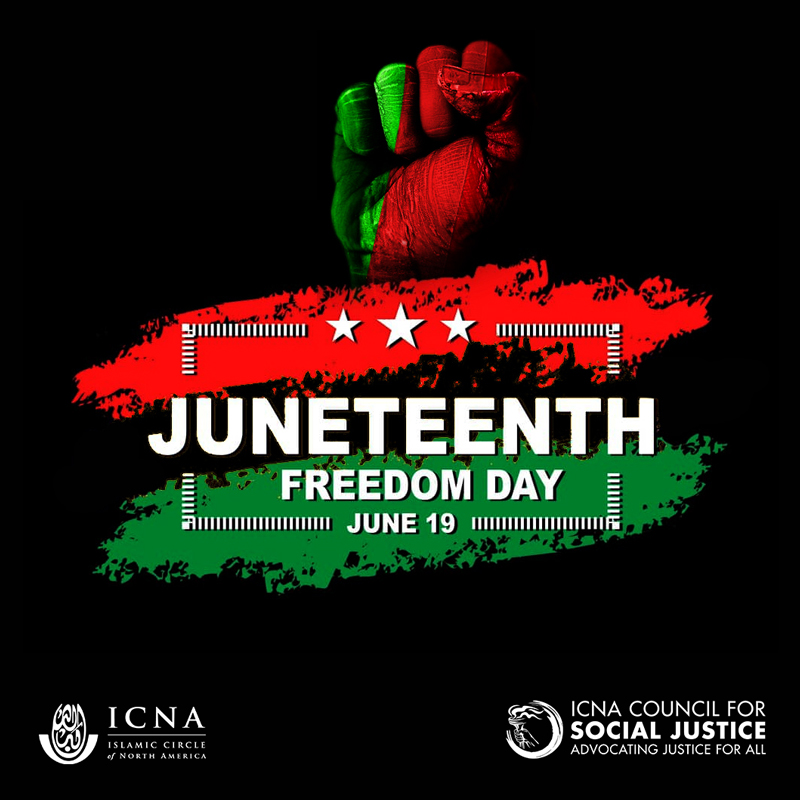
Dear Brothers and Sisters, Assalamu Alaikum Wa Rahmatullahi Wa Barakatuh, As we mark Juneteenth, June 19th, as a federal holiday in the United States, it is important for us as Muslims to pause, reflect, and act. Juneteenth commemorates the day in 1865 when the last enslaved African Americans in Galveston, Texas, were informed of their freedom, two and a half years after the Emancipation Proclamation had been signed. It is a day rooted in the painful history of slavery, yet one that affirms the resilience, dignity, and contributions of African Americans in the ongoing struggle for justice and liberation. As Muslims, we are called by our faith to stand firmly for justice, even if it be against ourselves or those close to us (Qur’an 4:135). Commemorating Juneteenth is not simply an act of historical remembrance, it is an active commitment to recognizing and supporting the continued fight for Black liberation in America and beyond. This day reminds us not only of what has passed but of the continuing struggles many communities still face today. Let us commemorate this day through: ● Learning: Study and teach the history of Juneteenth, slavery, and systemic racism. Assign this as a topic in your weekly Neighbor Nets (Halaqahs/Usras). ● Volunteering: Support your local Inner City Empowerment Center. Dedicate time this weekend to service. ● Honoring: Recognize the legacy of African American Muslims and their foundational role in American Islam and justice movements. ● Observing: Reflect on Juneteenth through prayer, family discussion, community events, and educational forums. ● Connecting: Draw parallels between the African American struggle and global justice movements, including the plight of Palestinians and other oppressed peoples. Indeed, Juneteenth is not complete without acknowledging and committing to the liberation of all oppressed peoples. The legacies of slavery, colonialism, and occupation are not confined by national borders nor consigned to the past; they persist today through systems like the prison-industrial complex, where mass incarceration and forced labor disproportionately impact Black communities. Whether in the American South or the occupied Gaza and West Bank, we see parallel patterns of dispossession, systemic violence, and resistance. One of the painful intersections is the controversial practice of U.S. law enforcement receiving training from Israeli military forces. Indeed, these exchanges risk normalizing aggressive tactics used in occupation contexts and will contribute to increased militarization and police brutality within marginalized communities in the United States, especially Black and Brown neighborhoods. In this light, Juneteenth is not just a historical milestone, it is a call to action. A reminder that while slavery may have been formally abolished, the fight against racism, state violence, and systemic oppression continues. As Muslims, we must be allies in that fight. As Muslims, we are called to act, not merely in word, but through meaningful commitment and service to justice. Let us honor Juneteenth by committing ourselves to building a society, and a world, rooted in justice, equity, and compassion. Let us stand with the oppressed, support the marginalized, and lift the legacy of those who struggled before us. May Allah (SWT) guide us in this pursuit and accept our efforts. Sincerely, Salman Y. M. Secretary General Islamic Circle of North America
ICNA at the 10th National Muslim Advocacy Day on Capitol Hill
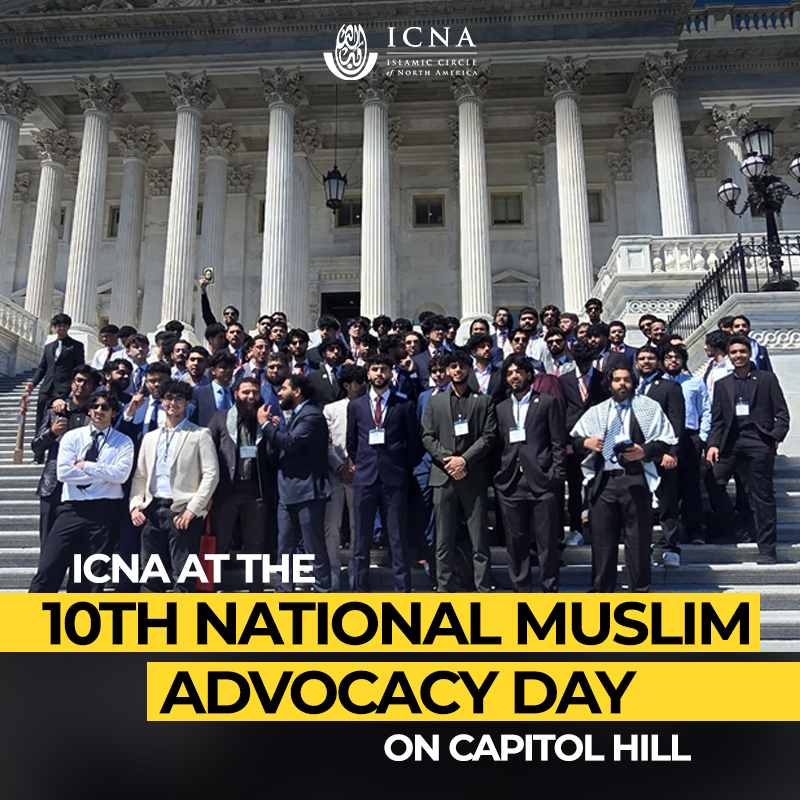
Alhamdulillah, ICNA marked a historic presence at the 10th Annual National Muslim Advocacy Day on Capitol Hill, hosted by the U.S. Council of Muslim Organizations (USCMO). This milestone event brought together Muslim leaders, activists, and constituents from across the nation to engage directly with members of Congress on pressing domestic and international issues. Under the theme “Defending Rights, Shaping Policy,” the 2025 National Muslim Advocacy Days centered on urgent and timely issues—including the protection of free speech, safeguarding students and campuses from threats and intimidation, defending civil rights and religious freedoms, and responding to grave humanitarian crises in Gaza and Sudan, as well as the ongoing persecution of Uyghur Muslims in China. The event powerfully underscored the critical need for the American Muslim community to hold elected officials accountable and to remain actively engaged in shaping national policy. ICNA’s delegation was the largest in the country, with nearly 325 registrants from 19 states, including nearly 200 dynamic youth and young adults from Young Muslims (YM). ICNA Sisters were also prominently represented, led by Sr. Sumaira, showcasing ICNA’s commitment to fostering inclusive civic participation. At the Capitol Hill evening reception, ICNA was honored as the top participating organization with the highest number of attendees. ICNA President Br. Saad Kazmi graciously invited Br. Ammar Siddiqui from Young Muslims to accept the award on behalf of the movement. The recognition highlighted ICNA’s strong grassroots infrastructure and the youth organizations growing role in national advocacy. Prominent guests included Congresswomen Rashida Tlaib, Ilhan Omar, and Latifa Simmons, along with leaders from major national Muslim organizations. Their attendance served as a reminder of the increasing visibility and impact of American Muslims in the civic and political spheres. Logistics for ICNA’s participation—including webinar-based training, hotel accommodations, transportation, meals, meeting schedules, and event coordination—were expertly managed by the ICNA Council for Social Justice (CSJ) team. A special hotel-based evening session, also hosted by CSJ, brought together six ICNA Ameers: Dr. Talat Sultan, Br. Zahid Hussain, Br. Naeem Baig, Br. Javaid Siddiqi, Br. Mohsin Ansari, and Br. Saad Kazmi, alongside ICNA Sisters President Sr. Sumaira. This Advocacy Day continues a tradition that began in 2015 when USCMO first launched this initiative to connect Muslim communities with lawmakers and advance a legislative agenda rooted in equality, social justice, and religious freedom. It has since become a powerful platform for fostering lasting relationships between American Muslims and policymakers, promoting a more inclusive and just society for all. In follow-up, CSJ will conduct a survey of attendees to gather feedback, identify areas of improvement, and encourage continued local engagement in advocacy efforts across the country, In Shaa Allah. ICNA President Br. Saad Kazmi encouraged attendees to carry the energy and training from the Advocacy Days back to their cities and towns, urging them to continue the vital work of social justice and advocacy at the local level. With meticulous planning and broad community support, this year’s event was executed seamlessly. May Allah swt accept the efforts of all involved and allow us to build upon this momentum in the service of our Deen and country. Ameen.
Passing of Pope Francis
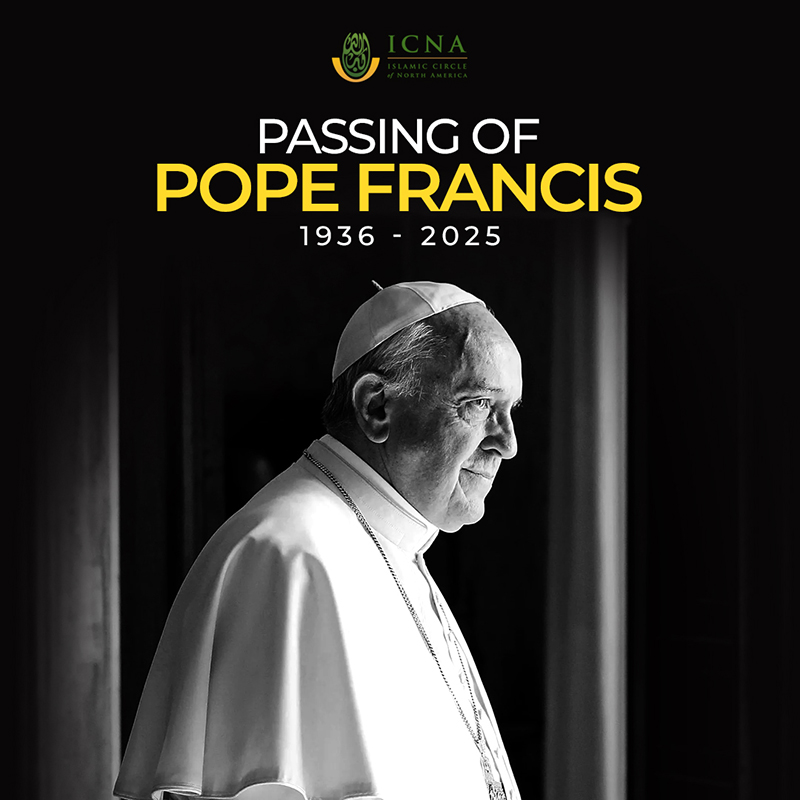
All Praises are for Allah Lord of all that exists, and peace and blessings of Allah be on His final Messenger and his household. ICNA is deeply touched by the passing of Pope Francis, who departed this world following a brief illness. We extend our heartfelt condolences to our Catholic partners in interfaith dialogue (National Catholic-Muslim Dialogue), the global Catholic community, and all those around the world who are mourning his loss. Pope Francis was a symbol of humility, compassion, and bridge-building, and his absence will be deeply felt across faith traditions and communities committed to peace and justice. This was so evident from his simple life-style. His life exemplified humility and compassion, marked by an unwavering commitment to the service of humanity. Pope Francis dedicated himself to uplifting the marginalized, advocating for peace, and promoting justice across all borders. His deep yearning for a more peaceful world was powerfully reflected in his final public message, delivered just a day before his passing, in which he called for an immediate ceasefire in Gaza. In his emotional appeal, he described the situation there as both “dramatic and deplorable,” underscoring his enduring concern for human suffering and his moral leadership until the very end. Pope Francis stood as a moral beacon in a world so divided, yet he consistently advocated for peace, justice, and compassion for the marginalized—even in the face of criticism and adversity. His steadfast dedication to building bridges between faiths and promoting dialogue rooted in mutual respect left a lasting impact that transcended religious boundaries. Through his words and actions, he inspired hope and understanding, not only within the Christian world but across the global interfaith community. As Muslims, we recognize the value of righteous leadership and the importance of standing together in times of both joy and sorrow. Pope Francis’s legacy of empathy, simplicity, and advocacy for the downtrodden resonates deeply with our own Islamic values. We pray that God, the Most Merciful, brings comfort to those mourning his loss and may his efforts toward unity and compassion continue to inspire generations to come.
In Tribute to Professor Khurshid Ahmad
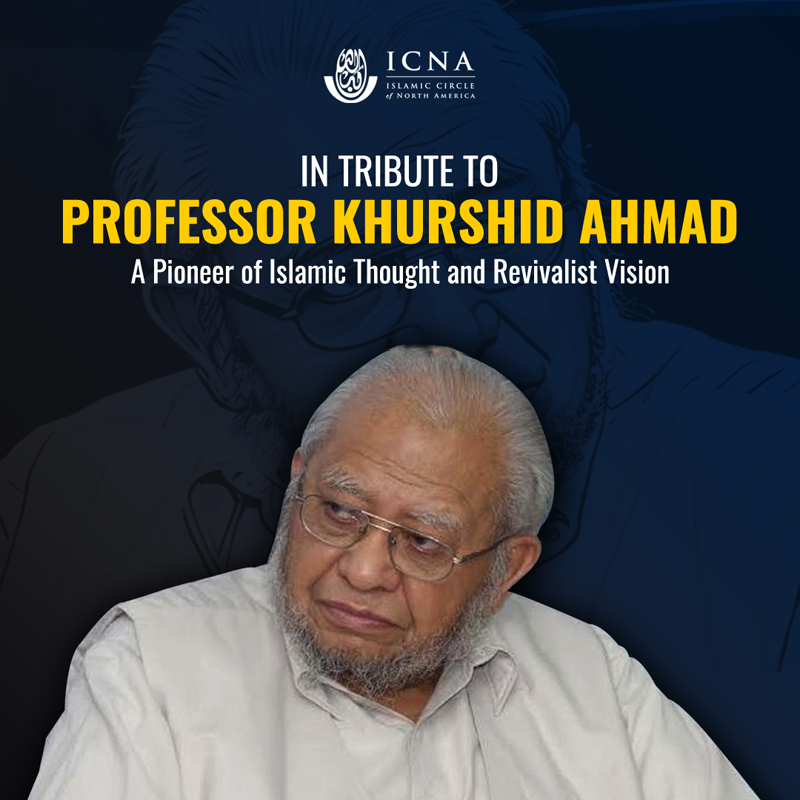
A Pioneer of Islamic Thought and Revivalist Vision “Among the believers are men who have been true to their covenant with Allah.” (Qur’an 33:23) It is with deep reverence that the Islamic Circle of North America (ICNA) mourns the passing of Professor Khurshid Ahmad (1932–2025), a distinguished scholar, visionary leader, and steadfast advocate for Islamic revival. His unwavering commitment to faith, intellect, and service has left an indelible mark on the global Muslim community. Born on March 23, 1932, in Delhi, Professor Ahmad migrated to Pakistan following the 1947 partition. He pursued his education with distinction, earning degrees in economics, law, and Islamic studies from Karachi University, and later completing a Ph.D. in Economics at the University of Leicester, focusing on Islamic economic jurisprudence. A pioneering figure in Islamic economics, Professor Ahmad co-founded the International Institute of Islamic Economics (IIIE) and played a pivotal role in establishing Islamic banking and finance as credible alternatives to conventional economic models. His scholarship emphasized the integration of Islamic principles into economic systems, advocating for justice, equity, and the eradication of exploitative practices. Beyond academia, Professor Ahmad was instrumental in shaping public policy in Pakistan. He served as the Federal Minister for Planning, Development & Statistics and as Deputy Chairman of the Planning Commission, where he worked to align national policies with Islamic values. His tenure in the Senate of Pakistan was marked by principled leadership and a commitment to the collective good of the Ummah. Professor Ahmad’s influence extended to the Western world, where he recognized the importance of building ideologically grounded Muslim communities. He co-founded The Islamic Foundation in Leicester, UK, fostering Islamic scholarship and education in Europe. His guidance and support were instrumental in the formation of ICNA, encouraging Muslims in North America to actively contribute to society while upholding Islamic values. A devoted disciple of Maulana Maududi, Professor Ahmad internalized and propagated the mission of Iqamat-ud-Deen—establishing Islam as a comprehensive way of life. He believed in Islam’s transformative power to address human suffering through its spiritual teachings and principles of justice and equality. Professor Ahmad’s life exemplified the ideals of servant leadership, humility, and unwavering dedication to the cause of Islam. His legacy serves as a roadmap for Muslims striving to fulfill their duties to Allah and society. We ask Allah (SWT) to shower His mercy upon Professor Khurshid Ahmad, forgive his shortcomings, accept his services, and grant him the highest place in Jannatul Firdaus. “Indeed, those who say, ‘Our Lord is Allah’ and then remain steadfast—on them the angels will descend, [saying], ‘Do not fear and do not grieve but receive good tidings of Paradise, which you were promised.’” (Qur’an 41:30) Islamic Circle of North America (ICNA) April 15, 2025
The Boosts and Benefits of Movement: The Role Exercise Plays in Ibadah

Ramadan recently came to a close, and I pray Allah (SWT) accepts all of our fasts, time spent in worship and fellowship, prayers, and pleas for repentance. I also pray He blesses us with life and vibrant health that we might welcome many more Ramadans in our lives and reap the blessings of this blessed month for years and years to come. Thinking ahead to future Ramadans, may Allah (SWT) bless me to see them, I’m reminded of what a friend shared with me about this most recent month of fasting. For the first time, she incorporated exercise into her routine. I was excited for her and encouraged her to keep going, but it got me thinking even more than I normally do about the importance of moving and exercising regularly, not only to keep ourselves healthy, but to honor the body Allah (SWT) entrusted to us, even when we are denying our bodies food and drink in a spiritual quest to become closer to Him. With Ramadan now in the rearview mirror, I hope many of you are jumping back into a regular fitness routine or looking to start one. Building stamina, flexibility, endurance, and strength are part and parcel of our faith as Islam certainly encourages care of our bodies. I’m sure many of us are familiar with Prophet Muhammad’s (peace be upon him) hadith concerning our health and the tremendous gift it is from our Lord. Narrated by Ibn Abbas, the Prophet (peace be upon him) said, “There are two blessings that many people are deceived into losing: health and free time.” (Bukhari 6412) You also may be aware of the Prophet’s (peace be upon him) advice to practice physical activities like horseback riding, swimming, and archery. Any of these and other exercise activities can ensure we are fit enough to stand long hours in taraweeh prayer in Ramadan, perform the strenuous rituals of the hajj, and complete our five daily salat prayers where we must stand upright, bend, prostrate and then lift our bodies back to standing, all of which takes muscular strength, endurance, and mobility. If you’re finding it difficult to commit to regular exercise, or if you tend to start strong but eventually find yourself unable or unwilling to maintain this healthy habit, perhaps a change in perspective might help you to find your way back to consistent movement. Like so many other things in our life, we Muslims can look to our beloved Islam for the answer. By doing so, we often find our worship is not only a boon to our spiritual health but to our physical health, as well. As mentioned, exercise helps us to fulfill many of the physical aspects of our worship. But did you know exercise also can improve brain function, notably our ability to concentrate? Think how this might elevate your salat or the time you spend reading Quran. How often do we find our minds wandering while we pray or when we are reading His word? Rather than being absentminded, we want to be focused on Allah (SWT) and the words we are reciting, hoping to deeply ponder and reflect on their meaning so that we might be more sincere in praising Him. Exercise might make this a bit easier, considering it improves blood circulation, thereby promoting increased blood flow and oxygen to our brains, resulting in better cognitive function and alertness. Additionally, when we work out our body releases neurotransmitters, namely serotonin and dopamine, which aid in putting us in a good mood, relieving stress, sharpening our focus, and helping us to be more motivated. If we could approach prayer and any other aspect of worship with a clear and alert mind, free of daily stressors and with a positive outlook, imagine how much more attention and concentration we could put on Allah! Remember, we have just come out of Ramadan, a month filled with discipline, commitment, and persistence of worship. Let us continue this momentum by honoring our bodies that Allah (SWT) blessed us with by taking good care of them, not only for the sake of how we feel, but for the sake of approaching our prayer and other acts of worship with a light and happy heart and a focused mind concentrated fully on Allah (SWT). Read Other Articles on messageinternational.org