


Eid Al Adha 2023
What comes to mind when you hear or read the word “sacrifice”? What about “surrender”? Historically, the word sacrifice, from the Latin sacrificus, or “making sacred,” generally referred to an offering someone would give to a deity. In Islam, we believe the very practice itself goes back to the first human beings, as we have in the Qur’an the story of Adam’s two sons, one whose ritual sacrifice (qurbaana) was accepted and the other rejected (Qur’an 5:27). In recent times, the word “sacrifice” has taken on a more secular meaning in most places, such as the act of giving something up with the possibility of attaining something greater in value, or to avoid some type of loss. In a sense, the former meaning includes the latter, as a literal offering is an act of devotion in which something of value is given up for something greater in return (e.g., the pleasure of God, protection from harm, etc.). In Arabic, the word referenced is usually nahr (sacrifice), such as Yawm al-Nahr (the Day of Sacrifice), which refers to the day of Eid al-Adha on which the hajj pilgrims offer a sacrifice as one of many ritual steps for hajj. This sacrifice is to commemorate the sacrifice of Prophet Ibrahim (Abraham), who was willing to sacrifice his own son at the command of Allah. The word nahr in the Qur’an is found in only one form in the entire Qur’an, and in the shortest surah, “so pray to your Lord and sacrifice” (Qur’an 108:2). It’s reasonable to opine about this ayah that the greatest physical act of worship, prayer, is pointedly paired with another of the greatest acts of worship, the sacrificial offering that takes place as the hajj concludes. This offering to Allah is the sacrifice of an animal (qurbani) or the financial contribution to that. A good portion of the meat is distributed to the poor. The pairing of acts together in the Qur’an is undoubtedly intentional, and a cause for reflection. Add to that, in our reflection upon verse 108:2, another verse, 22:37, in which we are told “Neither their meat nor blood reaches Allah. Rather, it is your piety (taqwa) that reaches Him…” In chess, one of the most popular board games in the world, players oftentimes sacrifice their own pieces in order to gain an advantage or to win the match altogether. In fact, it is not uncommon to sacrifice one’s most valuable piece, the queen, in order to win the entire match. In an educational setting, students sacrifice their time – precious as it is – in order to learn, attain certain grades, or for other benefits. In a work setting people sacrifice their time and other potential opportunities in life, in order to advance a business service or product, a nonprofit cause, or a humanitarian campaign, because they see value in it worth pursuing. Likewise, in relationships, husbands and wives recognize that all healthy marriages come with sacrifice. People sacrifice in order to get married as well as to maintain a healthy marriage. Similarly, parents sacrifice a great deal of time, energy, money, and worldly goals in order to raise their children, because they see some benefit or value in it, such as a continuous charity (ṣadaqah jariyah) for every righteous child raised, or for love, or other similar benefits. Continue Reading…
Harris Poll
Introduction We are pleased to present the findings of our Family Values and Gender Roles Snapshot, a comprehensive online survey conducted on our behalf by The Harris Poll. This survey provides valuable insights into the attitudes and beliefs of Americans as we delve into the realms of faith, changing social norms, and their profound impact on our society. This snapshot provides a unique window into the collective consciousness of Americans, offering a deeper understanding of how faith and evolving social norms shape our values and perceptions. By examining the intricate interplay between tradition and progress, we aim to shed light on the dynamic landscape of family values and gender roles in contemporary American society. The Family Values and Gender Roles Snapshot is an informative exploration of important topics, offering thought-provoking insights that challenge preconceived notions and inspire meaningful conversations. Our aim is to foster a greater understanding of the complex dynamics shaping our society today. FOR DONATION, CALL OUR HOTLINE (855) 855-ICNA donate now Changes In Social Norms Changing Social Norms: Redefining the Path to Happily Ever After Did you know that a staggering 74% of Americans believe that shifting social norms have made marriage less appealing to younger generations? From a growing focus on education and career growth to increased acceptance of cohabitation without being married, these factors are reshaping our perception of lifelong commitment. In fact, 26% of Americans strongly agree with this observation, highlighting the depth of sentiment surrounding cultural shifts. The Appeal of Marriage in Younger Generations Astonishingly, over 7 in 10 Americans aged 18-44 (73%) acknowledge that these evolving social norms have made marriage less appealing for younger generations Bridging the Generation Gap: Diverse Perspectives on Marriage When examining the survey data, a fascinating trend emerges. 80% of Americans aged 65 and above concur with the statement, whereas 72% of Americans aged 18-54 share this sentiment. These findings underline a significant generational divide in how changing social norms influence attitudes toward marriage. The Role of Faith: Insights from Religious Communities Interestingly, the survey also delved into the influence of religious beliefs on marriage attitudes. The results revealed that religious Americans are more likely than non-religious Americans to agree that changing social norms have made it less appealing for younger generations to get married (76% vs 69%). This highlights the diverse perspectives that arise from different spiritual beliefs. If you want to report out that language it would be Religious Americans are more likely than non-religious Americans to agree….(76% vs. 69) The Role of Religion: Religion is important in upholding traditional family values! Religion has significant impact on traditional family values. A substantial 69% of Americans believe that religion plays an important role in preserving these values, with 32% strongly agreeing. 🙏 Age and Beliefs: Shaping Perspectives Interestingly, Americans aged 35-44 (71%) and those aged 55+ (75%) are more likely to agree compared to individuals aged 18-34 and 45-54 (62% each). Some place a higher emphasis on religion in upholding traditional family values. 💪 The Power of Conviction: Influence of Religious Beliefs The data also reveals that religious individuals significantly align with the importance of religion in upholding traditional family values. A striking 81% of religious Americans agree, in contrast to only 35% of non-religious individuals. Moreover, the disparity continues with 40% of religious individuals strongly agreeing, compared to just 10% among their non-religious counterparts. Conflicts with Americans aged 35-44 agreeing-change to “some generations” or remove 35-44 part The Impact of Traditional Family Values: A Predicted Rise in Divorce Rates An overwhelming two-thirds (67%) of Americans believe that the U.S. will experience an increase in divorce rates due to this lack of commitment, with 29% strongly agreeing. 🔍 Perspectives by Age Group: Insights Unveiled When examining the data by age group, it becomes apparent that Americans aged 55+ (69%) are more likely to agree compared to those aged 18-34 (62%). This generational suggests varying perceptions regarding the connection between traditional family values and divorce rates. 🙏The Influence of Religious Beliefs: A Crucial Factor Religious affiliation plays a significant role in shaping opinions on this matter. A substantial 72% of religious Americans agree, while only 52% of non-religious individuals share the same sentiment. The disparity continues, with 33% of religious Americans strongly agreeing, in contrast to 20% among non-religious individuals. The Influence of Individualism and Changing Gender Roles on Traditional Family Values A majority of Americans, over 3 in 5 (64%), believe that individualism in American culture has contributed to the decline of these values, with 23% strongly agreeing. 🤷♂️ Gender Differences: Diverse Perspectives When examining the data, it becomes apparent that men are more likely than women to strongly agree with this statement (25% vs. 21%). These varying perspectives shed light on the complex relationship between individualism and traditional family values. 🙏 Religion and Beliefs: Shaping Perceptions Religious beliefs play a significant role in shaping opinions on this matter. A substantial 68% of religious Americans agree, in contrast to 53% of non-religious individuals. The disparity continues, with 25% of religious Americans strongly agreeing, compared to only 16% among non-religious individuals. 🚻 Shifting Gender Roles: A Contributing Factor Additionally, over 3 in 5 Americans (63%) believe that changing attitudes towards traditional gender roles have also contributed to the decline in traditional family values. Interestingly, men are more likely than women to agree with this statement (67% vs. 59%), with almost one-third of men (32%) strongly agreeing compared to 23% of women. SURVEY METHODOLOGY This survey was conducted online within the United States by The Harris Poll on behalf of the Islamic Circle of North America between May 4-8, 2023, among 2,053 U.S. adults ages 18+. Results were weighted where necessary by age, gender, race/ethnicity, region, education, marital status, household size, household income, and propensity to be online, to bring them in line with their actual proportions in the population. Respondents for this survey were selected from among those who have agreed to participate in our surveys. The sampling precision of Harris online polls is measured by
Inspiring Highlights from the Islamic Circle of North America Conference!
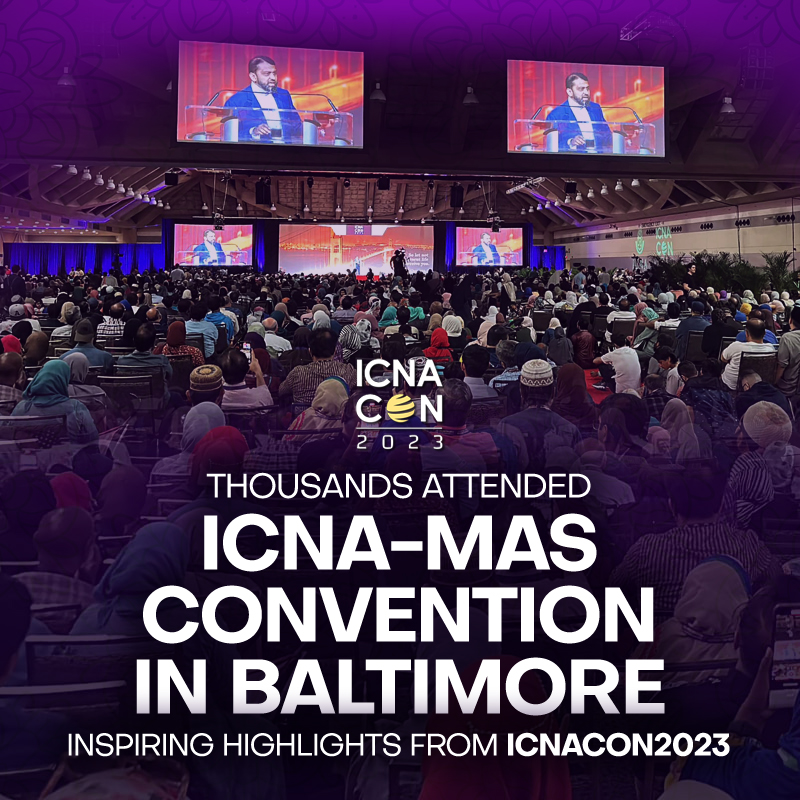
Thrilled to share incredible moments from the recent ICNA conference! It was a resounding success, fostering community engagement and knowledge sharing. Let’s dive into some highlights that made it truly special. Family Values and Gender Roles Snapshot: The conference started with the announcement of a comprehensive survey. The findings were astounding! 69% of Americans believe religion plays a crucial role in preserving family values. Even the Washington Times took notice! Matrimonial Session: One of the most anticipated events! It attracted countless individuals seeking meaningful connections within our community. The response was overwhelming, with enthusiastic participation and a vibrant atmosphere that exemplified unity. Diverse Speakers and Engaging Sessions: The conference featured 189 renowned experts who delivered captivating talks and facilitated 180 engaging sessions. Topics covered a wide range of interests and importance to our community. Knowledge was shared and minds were inspired! Vibrant Bazar: The conference buzzed with a bustling Bazar, featuring 193 talented vendors showcasing their crafts and products. Attendees explored unique items, supported local businesses, and engaged in enriching cultural exchanges. It was an experience like no other! Live Streaming and Qiyamul Layl: Accessibility was a priority! The conference offered live streaming options, allowing remote participation and benefiting from enlightening content. A special Qiyamul Layl session created a tranquil environment for night prayers and reflection. Youth Conference: Our dynamic youth conference drew over 7000 enthusiastic participants! The involvement of our younger generation demonstrated their passion, energy, and dedication to shaping the future of our community. The future is indeed in good hands! The convention received coverage from esteemed news outlets such as ABC News, Daily Pakistan, Turkish Media, and more. The impact extended far and wide, spreading the positive message of unity and empowerment. If you have any questions or want to delve deeper into specific aspects of the conference, feel free to reach out. We are here to provide further information and address inquiries. Thank you for your continued support! Stay tuned for more inspiring updates from ICNA. Together, we are building a stronger, more united community! 🤝🕌✨ #ICNACON2023
Eid Mubarak!
All praises are due to Allah ﷻ alone. On behalf of Islamic Circle of North America – ICNA, I would like to convey Eid greetings and best wishes to all the brothers and sisters in Islam. We ask Allah SWT to accept our Ibadah, our prostration, our Qiyam and our Siam(fasting), and all the duas which we have made during this holy month of Ramadhan. We thank Allah SWT for giving us an opportunity to spend this month of Ramadhan in peace and in harmony. But my brothers and sisters, there are hundreds and thousands of Muslims across the world who are facing hardship and oppression. The images from Aqsa of young men with their faces down and hand-tied to the untold stories of scholars and individuals who are working for the establishment of the Deen of Allah SWT, there is another year when they will be spending their Eid behind bars. Let’s pray together that Allah SWT relieves their difficulties and hardships. We at ICNA, Insha Allah, will continue our efforts to help relieve the pain and misery of brothers and sisters throughout the world, and also we believe in collective success. Hence ICNA will continue its struggle to revive the moral, ethical, and family values in the society where we live in. In the end, I will request you to please remember ICNA and its workers into your duas. Also, my dear Muslim Families! The much-awaited ICNA convention is coming and better than ever! This year, on May 27th-29th, join us in Baltimore for a memorable experience you won’t want to miss. We’ve already received numerous registrations, and we can’t wait to see you all, Insha Allah. As we celebrate this joyous occasion, we extend our warmest wishes for a blessed and happy Eid Mubarak from all of us at ICNA. Your Brother in Islam, Mohsin Ansari, MDPresident Islamic Circle of North America (ICNA) Donate Now!
ICNA Condemns the violence at Masjid-ul Aqsa by Israeli forces!
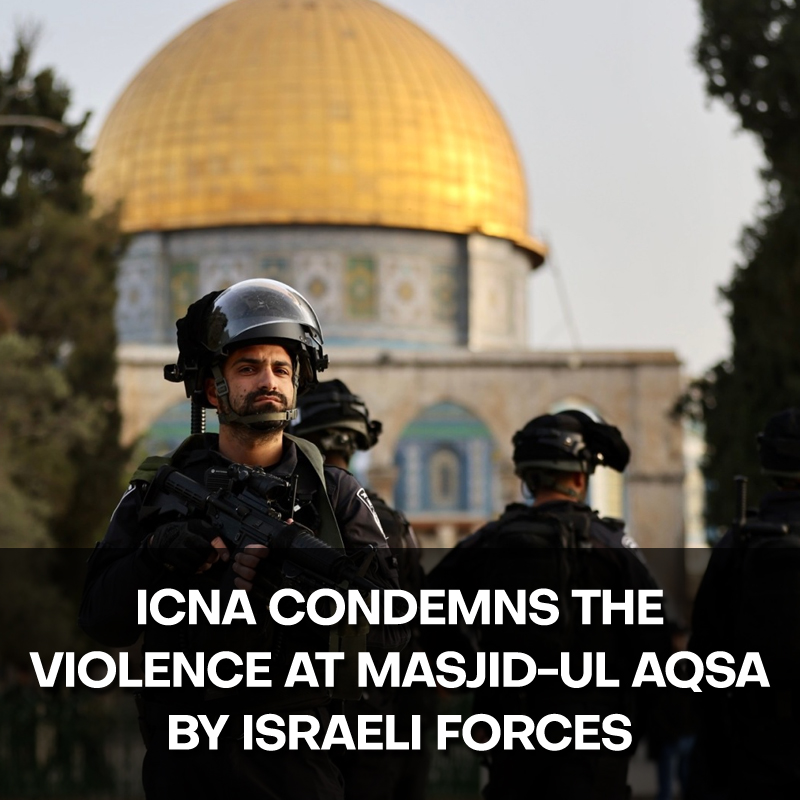
Issued on: 4/6/2023 ICNA joins the rest of the world in their condemnations following the recent violence and attacks on Palestinians by Israeli security forces during this holy Month of Ramadhan. It is a despicable and cowardly act of violence that has caused harm and fear to innocent worshippers. It is reported that Israeli police carried out this raid which resulted in least 12 Palestinians injured and around 400 innocent Palestinians arrested and are still in Israeli custody. This seems to be a yearly onslaught of Israeli forces to Palestinian Muslims during the holiest time of the year and at Islam’s third holiest site. This act of brutality without any provocation is in total violation of international laws. So once again, Israel shows a total disregard for any international law. Places of worship should be respected and protected as they represent a sacred space for people of different faiths to practice their religion in peace. Such violent acts are unacceptable and go against the values of compassion, tolerance, and respect for human life and values that we should all uphold. For this reason, we Muslims have condemned when synagogues are desecrated or Jews killed in their places of worship. ICNA calls on the government of the USA and the UN to bring the Netanyahu’s government to accountability the same way they bring Putin to accountability for waging a war with Ukraine. They cannot raise their voices when civilians are killed in Ukraine and remain absolutely silent and blinded to the atrocities of the Palestinian people that have been going on for years. There is only one word that describes that and it is: hypocrisy! In this Blessed Month of Ramadhan, we ask Allah SWT for His help against the Israeli brutality. We stand in solidarity with our Palestinian brothers and sisters and we say: Free Free Palestine! Independent Palestine! (Photo Credit: Reuters)
The Ultimate Roadmap: Ramadan of the Righteous
By Sh. Suleiman Hani What if you knew with conviction that Ramadan was a life-changing month of opportunities, blessings, and forgiveness, and that this Ramadan would be your last? Ramadan is the month in which the Qur’an was revealed, and a month Allah chose as one of increased forgiveness, mercy, accepted prayers, and multiplied rewards. Some people learn about Ramadan practices from their parents, friends, communities, and/or scholars, but sometimes end up missing some foundational elements in their practices during Ramadan. How do we know what the best practices are during the month of Ramadan? The Prophet (s) reportedly said, “The best of generations is my generation, then those which follow them, then those which follow them” (Muslim). Therefore, the most reasonable and reliable source is the Prophet’s practice during Ramadan, and that of the early generations of believers. Stage I: The Preparation for Ramadan The month before Ramadan, Sha’ban, is the month of preparation for those who want to maximize their potential in Ramadan. Sha’ban is a proof of heartfelt intention for the one who wishes to get closer to Allah SWT during Ramadan. Sha’ban is a proof for the one who is sincerely passionate about living to another Ramadan and hoping and praying that their previous Ramadan was accepted. Sha’ban is the month for the conscientious who plan to properly set the foundations for the month of Ramadan. Sha’ban is the month referred to as the month of reciters, for the companions increased their recitations of the Qur’an in order to maintain momentum throughout Ramadan. Aishah (r) said: “I never saw the Messenger of Allah fasting for an entire month except in Ramadan, and I never saw him fast more than he did in Sha’ban.” Usamah ibn Zayd (r) said: “I said, ‘O Messenger of Allah, I do not see you fasting in any other month like you fast in Sha’ban.’ He (s) said: ‘That is a month to which people do not pay attention, between Rajab and Ramadan, and it is a month in which deeds are lifted up to the Lord of the worlds. I like for my deeds to be lifted up when I am fasting.’” Anas (r) said, “When Sha’ban would commence, the Muslims would dedicate themselves to the recital of the Quran” (Lata’if al-Ma’arij). Ibn Rajab al-Hanbali (r) writes: ‘Since Sha’ban is a prelude to Ramadan, Islam encourages certain deeds in this month, that are usually done in Ramadan, such as fasting and Qur’an recitation; this prepares the soul to welcome Ramadan, when it arrives, with open arms” (Lata’if al-Ma’arif). Stage II: Ramadan Arrives Abu Huraira reported that The Messenger of Allah (s) said: “When the month of Ramadan begins, the gates of the heaven are opened, the gates of Hellfire are closed, and the devils are chained” (Bukhari). Talhah ibn ‘Ubayd reported that whenever the Messenger of Allah (s) saw the crescent moon, he would say, “O Allah, bring it over us with blessings and faith, safety and Islam. My Lord and your Lord is Allah” (Sunan al-Tirmidhi). The Station of Motivation How rewarding can your next 720 hours be if Allah decrees for you living to the end of Ramadan? It helps the believer to know the rewards and blessings of the month of Ramadan in order to be strongly motivated and consistent throughout the month and beyond it. The great companion Talha bin ‘Ubaidullah (r) narrated that two men came to the Messenger of Allah (s) and became Muslim together. After accepting Islam, one of them would strive harder than the other. The one who used to strive harder went out to fight in the way of Allah and was martyred. The other man who accepted Islam at the same time as the martyr lived a year longer, then he also passed away. Later Talha reported that he saw in a dream that he was at the gate of Paradise, and he saw those two men that had died. Then through the gates of Paradise someone came out and admitted the one who had died last into Jannah, then he came out again and admitted the one who died first as a martyr. Then he came back to Talha and said, “Go back, for your time has not yet come.” The next morning, Talha told people of the dream and they were amazed. News of that reached the Messenger of Allah (s). The Prophet (s) said, “Why are you so amazed at that?” They said, “O Messenger of Allah, the first one was the one who strove harder, and he died a martyr in the cause of Allah, but the other man was … Continue Reading
Sneak Peek: Historical Events of Ramadan
The Battle of Badr Ghazwah Badr (Battle of Badr) is the first battle fought between Islam and Kufr, taking place in the month of Ramadan. The Battle of Badr played a key role in the spread of Islam and served as a foundation of strength where Muslim warriors displayed great courage and bravery despite being fewer in number and lacking weapons and shields. Allah SWT grants victory only to those who believe in Him and put their complete trust in Him. Today, if we show willingness to sacrifice our wealth and lives for the sake of Allah SWT and adhere to the teachings of Allah’s Messenger (S.A.W.), Allah SWT will alleviate our hardships and grant us victory. May Allah SWT give us the ability to follow his deen. Aameen. The Conquest of Mecca The Conquest of Mecca is a great display of courage and bravery. It was bloodless and ended years of fighting and brutality between the Quraysh and the Muslims. On the 20th of Ramadan, Makkah was conquered under the leadership of Hazrat Muhammad (P.B.U.H), and Muslims were granted success after enduring long hardships, as the Quraysh had surrendered to the Muslims. Special prayers and salah are performed on the 20th of Ramadan in remembrance of this historical day. Through his treatment of the Quraysh, the Prophet demonstrated his faith in peace, non-violence, freedom, human rights, and equality for all human beings. “Whoever saves the life of one, it is as if he saved the whole of mankind.” (Qur’an 5:32) The Battle of Guadalete The Battle of Guadalete was fought on the 22nd of Ramadan, 711 CE, between Muslims and Visigoths. The army commander, Tariq bin Ziyad, led 12,000 soldiers with bravery, resulting in victory and the death of King Roderic. This marked the beginning of the Muslim conquest of Spain and the defeat of half of Europe, leading to Muslim rule in Spain for eight centuries. Whether you are fasting this Ramadan or not, your support can help us reach more people who are struggling to survive each day. The Battle of Ain Jalut The Mongol Empire is the largest empire in history. The Battle of Ain Jalut was fought between the Bahri Mamluks of Egypt and the Mongol Empire on the 25th of Ramadan, 658 AH, marking the limit of Mongol conquests. Hulagu Khan was the Mongol ruler who conquered most of Western Asia, but later the Muslim Mamluks defeated the Mongols in many battles. In addition to the Mamluks’ victory at Ain Jalut, the Mongols were ultimately defeated, leading to the expansion of the Muslim world.
Ramadan Kareem
All praises are due to Allah ﷻ alone. As we welcome the holy month of Ramadan, a time of blessings and spiritual growth, let us take the opportunity to improve our relationship with Allah and the Quran. During this time, we should also remember our brothers and sisters around the world who are facing hardships. Whether in China, among Uyghur Muslims, or in Palestine, India, or Kashmir, they all need our prayers and support. This Ramadan brings a new challenge as we witness an increase in immorality, indecency, and vulgarity around us. Let us use this month to improve ourselves and prepare to fight against this onslaught of negative influences in our communities, preparing ourselves and our families to face this challenge. We must also remember that our relationship with the Quran and charitable actions will help us achieve this goal. Inshallah, we will be able to achieve our target of praising our Lord. Your Brother in Islam,Mohsin Ansari, MDPresident Islamic Circle of North America (ICNA) Donate Now!
Women’s History Month
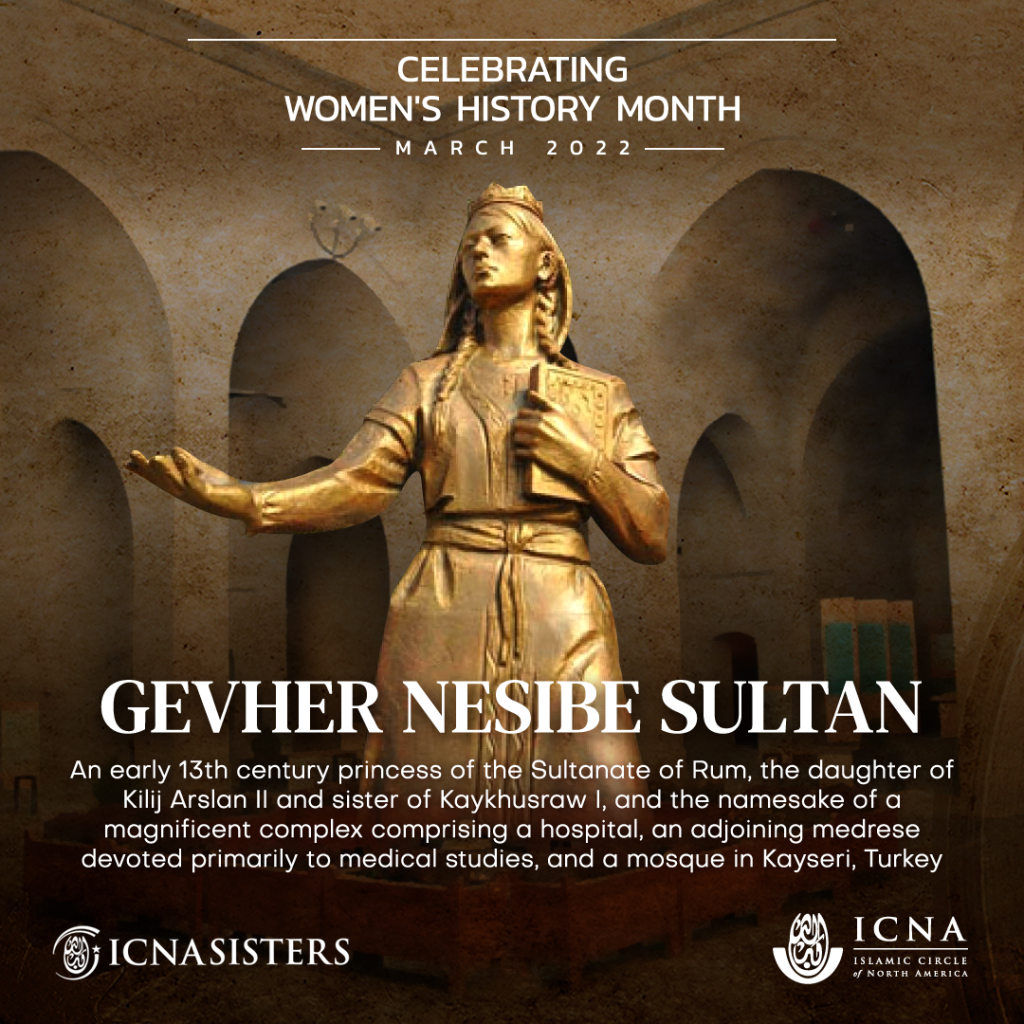
Gevher Nesibe Sultan 13th Century Gevher Nesibe Sultan “was an early 13th century princess of the Sultanate of Rum, the daughter of Kilij Arslan II and sister of Kaykhusraw I, and the namesake of a magnificent complex comprising a hospital, an adjoining medrese devoted primarily to medical studies, and a mosque in Kayseri, Turkey. The complex (külliye in Turkish) that she endowed, is considered one of the preeminent monuments of Seljuk architecture. The hospital was built between 1204 and 1206, and the medrese, whose construction started immediately after Gevher Nesibe’s death in 1206, was finished in 1210. The complex takes its name from the princess. The medrese within is known under a variety of names: the Gevher Nesibe Medrese; the Çifte Medrese (Twin Medrese); or as the Gıyasiye Medrese, after Ghiyath al-Din Kaykhusraw I, who was responsible for its construction. The tomb within the medrese is said to belong to Gevher Nesibe. Sutayta Al-Mahmali 10th Century Sutayta was taught and guided by several scholars including her father. She died in the year 377H/987CE. Sutayta did not specialize in just one subject but excelled in many fields such as Arabic literature, hadith, and jurisprudence as well as mathematics. It is said that she was an expert in hisab (arithmetic) and fara’idh (successor calculations), both being practical branches of mathematics which were well developed in her time. It is said also that she invented solutions to equations which have been cited by other mathematicians, which denote aptitude in algebra. Although these equations were few, they demonstrated that her skills in mathematics went beyond a simple aptitude to perform calculations.